

Mastering Summer: A Parent’s Guide to Structured Fun and Life Skills for Kids
As the school year winds down and summer approaches, a familiar mix of excitement and apprehension fills the air for many parents. While the idea of sun-drenched, carefree days is appealing, the reality often brings challenges in maintaining order, productivity, and sanity. For me, with my kids finishing school next week, thoughts of summer schedules and keeping our household running smoothly are at the forefront of my mind. Over the past decade, we’ve experimented with various “systems” to navigate these months, always striving for a balance that fosters growth without stifling the magic of childhood. If you know me, you know I thrive on structure; schedules are truly my secret to staying sane. In fact, I’m quite passionate about them!

Our Guiding Philosophy: Structure with Flexibility
While some parents embrace a 100% free-range approach to summer, I’ve found that a thoughtful system works best for our family. Though I greatly admire the free-spirited nature of those parents – and I’m sure my children often wish they had a mother with a bit more “free-range” in her – our household benefits from a clear framework. However, let me be very clear: our kids are not scheduled every minute of every day, nor are they enrolled in a multitude of summer camps or outside activities. I prefer to call what we have a summer “system” rather than a rigid schedule, as it offers more flexibility.
Two core beliefs underpin our summer philosophy:
- Work Before Play: This isn’t just a catchy phrase; it’s a fundamental principle we instill. Children learn the value of contribution and responsibility when they understand that productive effort precedes leisure time.
- Embracing Boredom: In a world constantly vying for our children’s attention, we believe it’s perfectly healthy – even beneficial – for kids to experience boredom occasionally. It’s often in these quiet, unstructured moments that creativity sparks and imagination takes flight.
Personalized Goals for Every Child
Every year, as my children grow and their interests evolve, we sit down individually to discuss their personal goals for the summer. This collaborative approach gives them ownership over their time and aspirations. From learning new software like Photoshop or undertaking a woodworking project in the garage to mastering a new skill, their goals are diverse and exciting. Of course, I also introduce a few of my own objectives, ensuring a well-rounded and productive summer experience for everyone.
Evolving Our Summer Systems: From Cute Charts to Life Skills
Our summer “system” is far from static; it adapts and changes with the evolving needs and ages of my children. In the past, I dedicated time each night to filling out an official, super cute job chart. This visual guide outlined their tasks for the next day, ensuring they woke up knowing exactly what needed to be done.
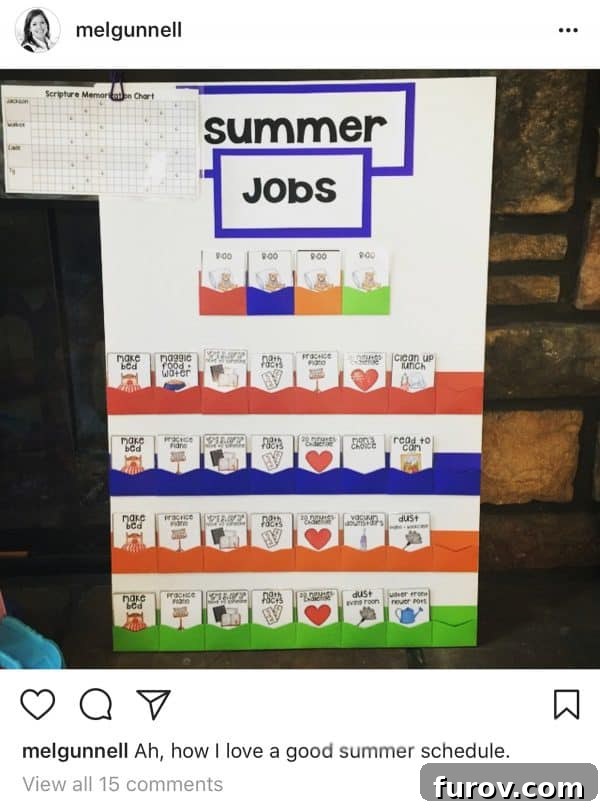
This system worked wonderfully for several summers, particularly for the younger kids. However, as my children grew older, they gradually “graduated” from such a “cutesie” approach. We then transitioned through a few summers where I would use a simple pen-and-paper system for the older ones, while the cute job chart remained for the littles. This year, my goal is simplicity: one cohesive system for all. This summer, my plan involves printing a single-page chart on cardstock, laminating it, and using a dry-erase marker for the kids to check off their completed tasks.
Beyond streamlining the format, I’m also refining our “everyday chore” system, shifting towards a more comprehensive life skills method. I’ve noticed that while my kids are great at doing bits and pieces of a job, tackling a task like cleaning a bathroom thoroughly, from top to bottom, can still be a daunting (and sometimes frightening!) challenge for them.
Our Current Summer System: Simplicity and Life Skills
This summer, our system is designed to empower my children with essential life skills while providing a clear structure to their days. It’s about building competence and confidence.
Daily Tasks for Growth and Routine
Each weekday, the children have a set of daily tasks they must complete by noon. Fridays are a designated “free day” for all tasks marked with an asterisk (*), offering a well-deserved break and an incentive for diligent work throughout the week:
- Pick up room/make bed: A foundational habit for personal organization and a tidy home environment.
- Reading (30 mins): Encouraging literacy and a love for books, preventing the “summer slide” in academic skills.
- Typing* (1-2 lessons per day): Our goal is for children aged 10 and older to reach 40 words per minute (wpm) by the end of summer. We’ve found typing.com to be an effective, albeit no-frills, resource. It gets the job done, and they earn a game after completing each level. In the past, we used “Typing Instructor for Kids” software, but it wasn’t compatible with our Macs. If anyone has recommendations for engaging typing programs, I’m all ears!
- Practice piano/cello* (30 mins): Fostering musical talent and discipline.
- Math facts* (10 mins): Reinforcing foundational math skills to keep their minds sharp.
- Dad’s outside job list: My husband, Brian, prepares a list of outdoor tasks each morning, teaching them about yard work and maintenance.

Weekly Life Skill Assignments
In addition to daily responsibilities, each child receives a weekly job assignment. These tasks focus on more comprehensive household duties, designed to teach them how to complete a job from start to finish. These cleaning jobs must be completed and checked off by me by Thursday at noon. The only caveat is that if we have company or a special event, I might (nicely) ask them to complete the job sooner.
With five children, we rotate through these five weekly assignments. While I provide assistance to my 6- and 8-year-olds, I expect my 10-, 12-, and 14-year-olds to be able to complete these tasks adequately on their own, with initial training and guidance.
Weekly Tasks:
- Vacuum whole house, including stairs: Learning attention to detail and thoroughness.
- Dust entire house room-by-room and help plan and prepare one dinner this week: Combining cleaning with practical culinary skills and meal planning.
- Clean bathrooms top to bottom (we have 2.5 bathrooms): This is a major life skill! It teaches them thoroughness, hygiene, and the proper use of cleaning supplies.
- Clean up breakfast every day this week and prepare one hot breakfast this week: Responsibility for daily cleanup combined with basic cooking skills.
- Clean up lunch every day this week and prepare one lunch (hot or cold) this week: Similar to breakfast, fostering independence in meal preparation and cleanup.
Five kids, five weekly assignments. It creates a structured rotation that ensures everyone contributes meaningfully. (You can view a PDF of the chart I designed for a visual reference.)
The Enduring “Room Job” Chart
We also utilize a “room job” chart that has been a staple in our family for years. This system, which we use year-round, not just in the summer, assigns responsibilities like cleaning up dinner, tidying various rooms in the house, wiping down the guest bathroom, and feeding our animals. It’s a true wonder for our family and the longest-running job system I’ve ever implemented. This little wheel genuinely saves my sanity on a daily basis.
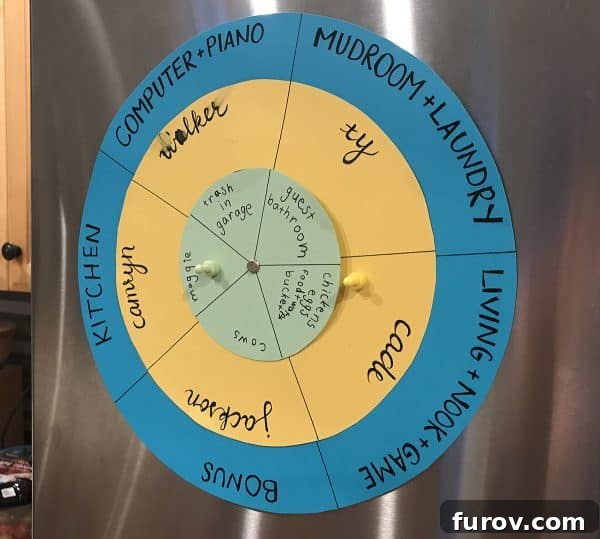
I periodically update it when we need to add new tasks or make adjustments. Every single day, around or just after dinnertime, I simply call out “Room jobs!” and everyone knows exactly what I mean. They (hopefully) spring into action. And trust me, if one of them is lagging on the couch, a sibling will quickly call them out to get moving – a testament to the power of #siblingaccountability!
Cultivating Responsibility and Independence
I’m not entirely sure how this new weekly job system will unfold this year, as it’s our first time implementing it. However, Brian and I frequently discuss our desire to raise functional, responsible children who understand the importance of work, how to finish a task thoroughly, and yes, how to clean a toilet properly. That’s the overarching goal for this summer.
I’m still working on delegating laundry. The thought of offloading this responsibility fills me with a bit of dread – I worry for my life, our septic tank, and the condition of all the clothes in our house! While my children do an excellent job of folding all the clothes (as seen on our room job chart), I still handle the washing. It’s a work in progress!

Balancing Chores with Unforgettable Fun
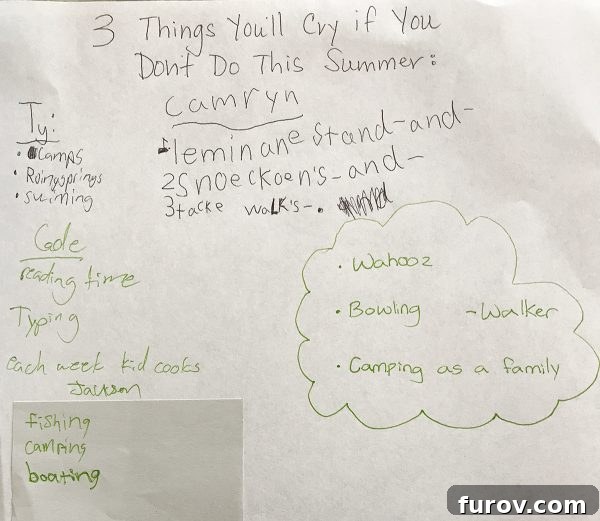
Lest you imagine my children are the most disadvantaged kids in history, with a summer entirely consumed by chores, let me assure you that is far from the truth. At the beginning of each summer, I ask them to list three things they would be truly sad not to experience or do during the warmer months. Their answers are always enlightening, providing valuable insight into their desires. We then make every effort to bring many of these wishes to fruition, assuming the list doesn’t involve international travel or anything that would require selling a child to afford!
Kids’ Wishlist for Summer Adventures
So far, this summer’s list is wonderfully doable and full of classic childhood joys: setting up a lemonade stand, indulging in sno cones, taking leisurely walks, going bowling, camping under the stars, each child cooking a meal one week, and fishing. These activities offer a perfect counterpoint to their daily and weekly responsibilities.
Since all daily jobs are typically completed by noon (and often much earlier, as we still rise by 7:15 a.m. during the week for family scripture reading – much to my teenager’s dismay!), they have the entire afternoon free. This precious time is dedicated to playing basketball in the front yard, running through the sprinkler under the trampoline, working on their individual summer goals (like woodworking or Photoshop), following their favorite drawing tutorials on ArtHub, and, you know… getting delightfully bored! 🙂
Embracing the Power of Boredom
This brings me to a crucial element of our summer strategy: the Boredom Busters Chart. This laminated chart is a permanent fixture on our fridge throughout the summer months (it comes down during the school year). My kids have learned not to even approach me with the dreaded phrase “I’m bored” because the most likely response will be either another job to do or an invitation to join whatever project I’m currently tackling (this summer, that will involve a lot of indoor room painting!).

Consequently, they often consult the chart themselves and usually manage to find something engaging to do, though some ideas require mom’s approval. And if, by some miracle, they still find themselves writhing in boredom on the couch, moaning about all their friends being at Disneyland all summer long, I console myself with the knowledge that they truly do have abundant opportunities for creativity and fun, whether they recognize it in that moment or not.

The Boredom Busters Chart isn’t just for the kids; it’s a lifesaver for me too. Despite being a full-time stay-at-home parent (a blessing for which I am immensely grateful), I still need to carve out 3-5 hours daily for working on this blog, which, as you can imagine, demands a significant amount of dedication. While much of my work happens late at night, especially during the summer, I also designate specific “work hours” several days a week, usually from 1-3 PM (or whatever we decide that day). During these times, the kids are expected to entertain themselves and only approach me for the three critical “B’s”: blood, broken bones, or barf.
Adding Sparkle: New Summer Delights
Beyond our routines and established activities like weekly trips to the community library, a visit to the local waterpark, swim lessons, occasional trips to the community pool, and several cherished family reunions, I also make an effort to introduce one or two NEW things each summer. This keeps everyone excited and adds a fresh dynamic to our home, at least for the first couple of weeks – ha!
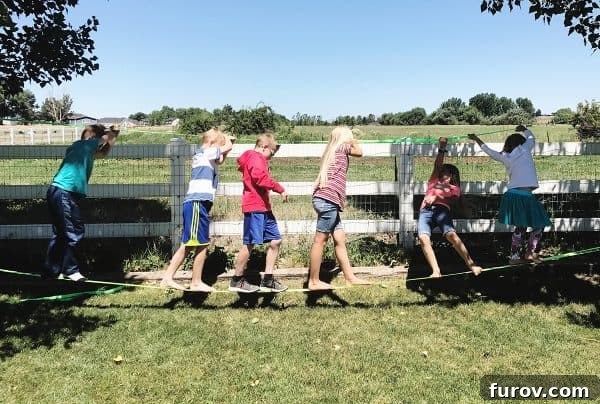
Last summer, it was a slack line (aff. link) that my parents had gifted them for Christmas the year before but we hadn’t yet set up. It stayed up all summer long and was an absolute hit, providing endless hours of fun and coordination challenges.
The big surprise for this summer is this impressive shaved ice machine (aff. link). A bit excessive, I know! It’s not for the faint of heart, but several friends who own the blue model (aff. link) of this popular machine rave about it constantly. The jury is still out on whether we’ll use it enough to truly justify the investment; I’ll keep you posted! (I’ll probably sell it if we decide it’s too much machine for us, haha.) If I had a neighbor with kids, I would have certainly pressured them into splitting the cost, but I’m optimistic we’ll get a ton of use out of it this summer, even if I haven’t quite figured out where to store it. My house is notoriously lacking in storage space – it might just have to take my side of the bed, and I’ll sleep on the couch!
Our Favorite Summer-Saving Resources
Beyond the scheduled activities and new additions, a few tried-and-true items consistently save our sanity and provide endless entertainment throughout the summer. Many of these have been birthday or Christmas gifts that continue to prove their awesomeness year after year:
- Bunch O’ Balloons (aff. link): For instant water balloon fights and cooling off on hot days.
- Free ArtHub Drawing Video Tutorials: A fantastic resource for creative expression and developing artistic skills.
- ThinkFun Games: These games are incredibly engaging and promote critical thinking. We especially love the Roller Coaster Challenge and the Tilt (aff. links).
- Snap Circuits (aff. link) and LEGOs: Timeless toys that encourage engineering, creativity, and problem-solving.
- Origami Tutorials: We find many free ones on YouTube and also use this easy origami book (aff. link).
- Plenty of Markers, Crayons, and Colored Pencils: Essential tools for spontaneous art projects and creative expression.
- Latch Hook Kits: A calming and engaging craft that yields satisfying results (look for 40% off coupons at craft stores!).
Fostering Entrepreneurial Spirit
Beyond chores and structured learning, Brian and I are deeply committed to encouraging the entrepreneurial and work-oriented side of life in our children. We believe in teaching them the value of earning money, understanding basic business principles, and developing a strong work ethic from a young age.
Early Seeds: The Donut Shop Dream
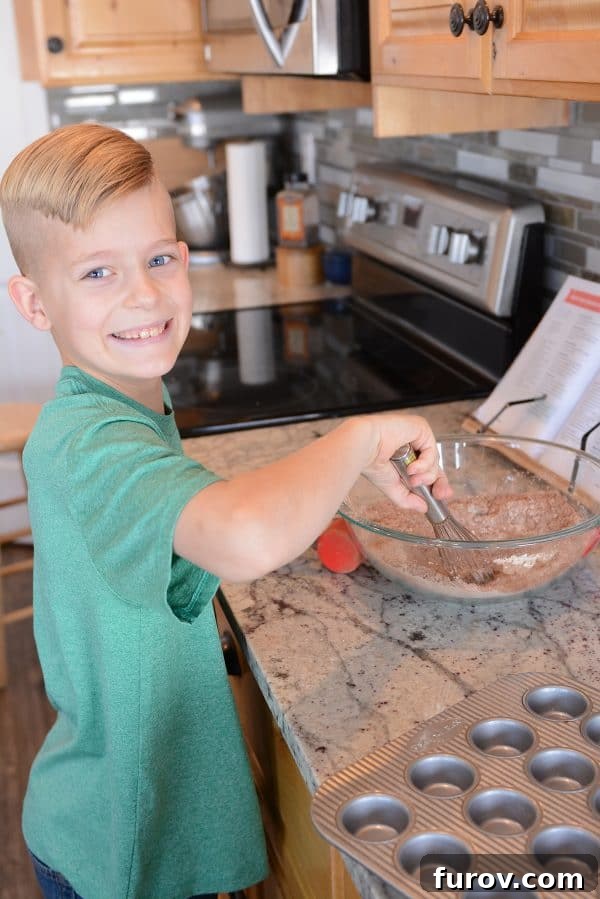
Our 10-year-old is already planning to open his very own donut shop this summer, selling homemade donuts and possibly cupcakes! His trial run a month or so ago, thanks to a fantastic recipe book sent by a frequent commenter, Liz, produced the best donuts ever. It’s exciting to see his enthusiasm and initiative in action.
Teenage Ventures: Learning the Value of Work
We’ve established a clear expectation: when our children turn 13, they are required to work 6-8 hours a week. Last summer, our then-13-year-old created flyers for lawn mowing, assisted a friend with a trash bin cleaning business, and secured several odd jobs doing yard work for people within our small community.
I won’t lie, it was a little painful at times. Most of his friends, according to him, were spending the summer playing video games and going on vacations. Working was probably the last thing he wanted to do as a 13-year-old. However, even he admitted by the end of the summer that he was thrilled about the money he had earned – and even more excited about the money he had put into savings. And selfishly, I was excited he wasn’t pestering his younger siblings all summer long!
We actively try to foster this “work” element by sitting down with him early to create a plan (and we’ll do the same for our other boys as they reach this age). We encourage him to find work he genuinely enjoys and are even willing to front money for businesses or projects, with the understanding that he will pay us back as he earns a profit.

This year, at 14, our requirement for him has increased to 10-12 hours of work per week. The underlying idea is that by the time he’s 16, the prospect of working a 40-hour-a-week summer job won’t feel overwhelming. He already has a job lined up to sand down and paint a swingset, and he’s also embarking on a flag-selling business, offering Boise State and BYU flags.
Navigating Summer with Intentionality
While detailing all these plans makes me feel a bit tired, I know that implementing them will be much smoother than it appears on paper. We approach each day one step at a time, and the inclusion of Fridays as a “free day” (yay!) provides a crucial break. Ultimately, our family thrives on structure, and everyone generally adapts well to the rhythm and expectations of our summer system.
My hope by the end of this summer is that we will all still feel like this:

Haha! In reality, I fully anticipate there will be ups and downs, and some days when everything feels like it’s falling apart. But my sincere hope is that our new-ish summer system will prove effective in fostering responsible, creative, and happy children.
Share Your Summer Strategies!
Do you have a summer system or unique strategies for keeping your kids engaged and productive? I would love to hear your thoughts and insights! I welcome all comments – please keep the discussion respectful and open to differing opinions.
Disclaimer: I am a participant in the Amazon Services LLC Associates Program, an affiliate advertising program designed to provide a means for me to earn fees by linking to Amazon.com and affiliated sites. As an Amazon Associate, I earn from qualifying purchases.