
Food Storage 101! Spreadsheets, reliable sources, and a wealth of practical tips to make planning and building both long-term and short-term food storage effortless, budget-friendly, and truly achievable for any household.
Mastering Food Storage: An Accessible & Affordable Guide
The phrase “food storage” often conjures images of daunting tasks, overwhelming expenses, or simply a concept that feels entirely foreign. For many, it’s a topic riddled with questions: Where do I even begin? Is it truly necessary? Will it be boring or expensive? However, for enthusiasts like me, it’s an exciting and empowering aspect of household management.
Today, I’m thrilled to finally share with you the culmination of nearly two decades of experience, research, and practical application. This guide brings together all the tips, trusted resources, and detailed spreadsheets I’ve developed and refined to create a food storage plan that genuinely works for my family. The best part? It’s designed to be easy, affordable, and completely doable for yours, too.
Why Is Food Storage Essential for Modern Living?
Following a recent post discussing emergency meal planning, the outpouring of comments, emails, and questions made one thing abundantly clear: food storage and other preparedness principles are very much on our minds, especially in light of the global circumstances we’ve all navigated recently.
Beth’s insightful comment perfectly encapsulates a widespread realization: “Not being of the Mormon faith, I always just assumed that the storage of extra food was a religious thing but a quick google search thing tells me it is just based on prudent living. I would be interested in the details of how you manage to keep stuff current, etc. Those of us with small basement pantries often find them out of date and useless. Any further info would be appreciated! Stay safe…..and healthy.”
Beth is absolutely correct! Establishing a manageable food supply in your home is, at its core, a matter of prudent and responsible living. Whether driven by the need to prepare for a pandemic, job loss, natural disaster, a desire to simplify your grocery budget, or any other unforeseen circumstance, an intentionally built food supply offers invaluable peace of mind and practical benefits. It’s about resilience, self-sufficiency, and ensuring your family’s well-being.
5 Foundational Principles for Building Your Food Storage Smartly
Embarking on a food storage journey can feel overwhelming, but adhering to these core principles will set you up for success, ensuring your efforts are both effective and sustainable:
- No One-Size-Fits-All Approach: Understand that what works for one family may not work for another. Your food storage plan must be uniquely tailored to your family’s needs, dietary preferences, available space, and budget. There’s no universal magic formula.
- Store What You Eat, Eat What You Store: This is arguably the most critical rule. Never store foods that you or your family dislike or rarely consume, regardless of online recommendations. Doing so is a waste of time, money, and valuable storage space. For example, if lima beans aren’t a family favorite, they have no place in your pantry.
- Avoid Extremes and Debt: Building a food supply should be a gradual, thoughtful process, not a sprint that leads to financial strain. Resist the urge to create a massive, immediate stockpile or an Instagram-perfect pantry if it means going into debt. Start small and build incrementally.
- Begin with a Single Day’s Supply: If you’re starting from scratch, the idea of months of food can be intimidating. Instead, focus on gathering enough food for just one day. Once you master that, expand to a one-week supply, then a one-month, and so on. This gradual approach makes the goal feel achievable.
- Embrace a “Living Food Storage” System: Ditch the outdated notion of a static, untouched stockpile hidden away for decades. Instead, cultivate a “living” food storage system where items are regularly rotated and used in your daily cooking. This approach prevents spoilage, ensures freshness, and integrates preparedness seamlessly into your lifestyle. I’ll explain how this transformative concept changed my life and how you can implement it.
A Gentle Reminder: Personalize Your Preparedness Journey
I cannot stress this enough: my system and resources are a template, not a mandate. The ideas, tools, and spreadsheets I’m sharing in this post are precisely tailored to my family’s specific needs and routines. They represent what works best for *us*.
Please take these insights, extract the elements that resonate with you, and adapt them to suit *your* unique circumstances. Above all, do not allow yourself to become overwhelmed.
I am providing a significant amount of information, and it would be easy to feel stressed or even frustrated by the sheer volume. That is the complete opposite of my intention today! My genuine desire is simply to offer helpful guidance and support as you navigate your food storage journey. Remember, every step, no matter how small, is progress.
Understanding the “Living Food Storage” Philosophy
My early experiences with food storage were shaped by my parents, who maintained an extensive collection of food in boxes, cans, and buckets. These supplies were meticulously tucked away in the deepest corners of cellars and closets. Yet, I vividly recall that those containers were almost never opened. I genuinely believe my mother eventually discarded much of it a few years ago because it had long expired and remained unused, despite being dutifully gathered, stored, and moved through over 20 houses across 40 years!
When I first married 18 years ago, I initially envisioned following in their footsteps: accumulating wheat in buckets and powdered milk in cans, stashing them under the bed. However, I soon faced practical realities: I didn’t own a wheat grinder, the thought of powdered milk was unappealing, and my husband rightfully pointed out that we couldn’t afford such a large initial investment.
So, for a while, I did nothing. And frankly, I was fine with that. It wasn’t until about five years later (around 2007) that I began to feel a persistent internal nudge to reconsider food storage. We were moving frequently, our family was growing rapidly with many babies, I had transitioned to working from home, and the idea of having a readily available food supply for emergencies or unexpected events became increasingly appealing.
After extensive research, conversations with knowledgeable individuals, and a gradual process of acquiring and building our family’s provisions, I arrived at a crucial realization: I wanted a living food storage system. This wasn’t about strictly separating short-term and long-term supplies into distinct categories, but rather creating something more integrated and dynamic.
My goal became an intentionally planned and assembled food storage that I could genuinely use every single day, naturally rotating and replenishing items as needed. This approach eliminated waste, ensured freshness, and transformed food storage from a dusty emergency cache into an active, valuable part of our household economy.
Diane’s comment from an earlier post perfectly echoes this philosophy: “Food storage doesn’t have to be a huge initial investment like some people think! I’m constantly restocking my pantry. It’s never an all-at-once thing. I watch for sales and that’s when I stock up. Or buy 2-3 items instead of just one (for example, if I’m getting low on soy sauce, I buy a couple extras to store in the pantry). If you have the mentality that you’re saving some for later, you can stock up a little at a time and it doesn’t add a lot of expense. Like you, I’ve learned to store what we eat and eat what we store. I have powdered eggs and milk and there have been multiple times where I started making something assuming I had eggs (or milk) because I always have those things, but realized I was down to my last egg or ran out of milk. The powdered varieties might not be good by themselves, but they work great for cooking!”
I couldn’t agree more with Diane’s practical and sustainable approach!
Practical Steps to Build Your Emergency Food Supply
1. Start with Detailed Meal Planning
The most effective way to begin is by understanding your family’s actual consumption. Plan out your meals for one day, or even better, for an entire month, and meticulously observe what your family truly eats.
Consider every category: grains, dairy, proteins, sweets, snacks, fruits, and vegetables. Make a comprehensive list of these foods and their typical quantities. Once you have a clear picture of your monthly needs, multiply that by three months. This gives you a tangible goal for a three-month supply.
2. Gradual Stockpiling and Smart Shopping
With your three-month goal in mind, you can start building gradually. Every time you go to the grocery store, simply pick up 1-2 extra items from your list. For instance, if you normally buy one can of diced tomatoes, buy two or three instead. Remember, there’s no need to buy everything at once! This method spreads the cost over time, making it far more manageable for your budget.
3. The Power of Rotation: Eat What You Store
This is crucial for a “living food storage” system. Do not, under any circumstances, shove your newly acquired foods to the back of your pantry or cupboards and forget about them! Implement a “first-in, first-out” (FIFO) rotation system. Use the older items first, ensuring foods stay fresh and are consumed long before their expiration dates. As you use an item, replenish it on your next shopping trip.
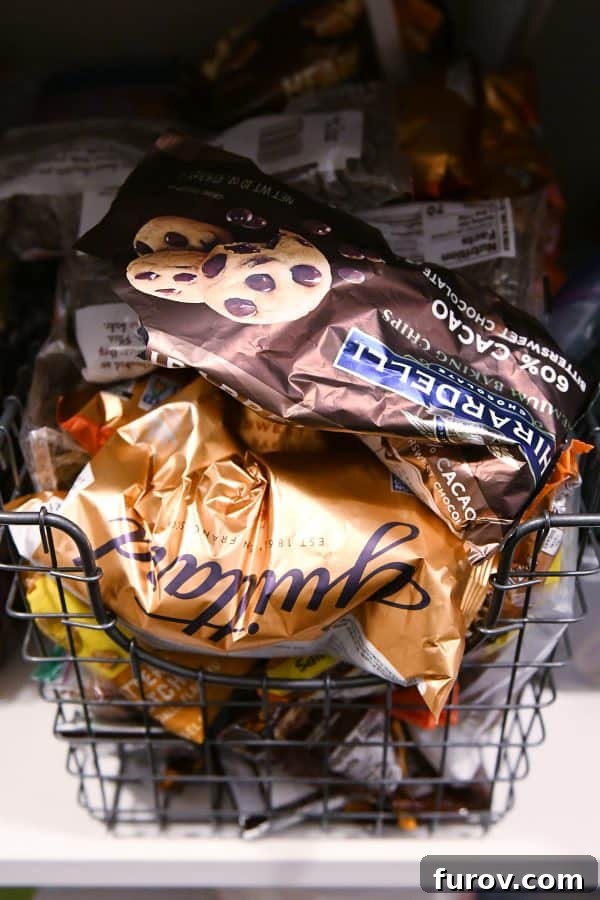
And whatever you do, do not forget to include the chocolate chips! (Yes, that is an open package of Ghirardelli 60% bittersweet chocolate chips on top of my pantry shelf in the photo below—because, hello, coping skills, and also, they are undeniably the best in the history of ever.)
As you begin with small steps and expand your supply as your budget permits, you’ll naturally discern the ideal package sizes to purchase, based on how quickly your family consumes certain items. Eventually, as you build a more extensive multi-month food storage, you might consider enhancing your pantry with a few larger containers or buckets of staple ingredients. I’ll detail how I integrate these larger staples into my personal living food storage system further below.
Streamlining Your Food Storage Management
The Essential Food Storage Tracking Sheet
While some might view this as excessive, I find a simple food storage tracking sheet to be invaluable. I keep it readily accessible near my pantry (it used to hang inside, but anxious little hands frequently knocked it down while sneakily grabbing Oreos!).
It’s not a complicated system; it’s merely a blank table. Whenever I open a new package or ingredient – anything from a fresh bag of quinoa to a new bottle of BBQ sauce – I quickly jot it down on the tracking list. Once the item is completely used and the empty package is discarded, my routine is to immediately head to the sheet and place a checkmark next to it. This then signals me to add it to my next grocery list.
This straightforward system ensures a continuous rotation and keeps our supply well-stocked, consistently maintaining at least a three-month reserve of our most used items.
Download: Food Storage Tracking Sheet – PDF
Access: Food Storage Tracking Sheet – Google Drive
Diving Deep with the Comprehensive Food Storage Spreadsheet
Now, let’s get into the intricate details of how I transform all these principles into tangible action.
A Personal Disclaimer: I am not a casual observer when it comes to food storage. I am a true-blue, dedicated, die-hard fan. I genuinely love it, believe in its importance, and actively utilize it. In fact, I hold a deep conviction (yes, truly) about its significance.
You absolutely do not need to share my level of enthusiasm! In fact, please don’t feel pressured to be exactly like me. Take all this information with a grain of salt (or two!) and adapt it to your comfort level and needs.
This gentle disclaimer was my way of easing us into the realm of The Great and Nerdy Food Storage Spreadsheet.
Friends, I admit, this spreadsheet is quite comprehensive, especially for someone seeking a slow and gentle introduction to food storage. It’s equipped with formulas and has taken me years—and more hours than I care to count—to assemble and even more time to fine-tune for sharing here.
If you enjoy manipulating numbers, calculating quantities, and planning down to the pound, this spreadsheet will be an invaluable tool for you.
But here’s the wonderful news: it’s also an excellent starting point for those who prefer to take things slow, easy, and gradually integrate food storage into their lives! You don’t have to dive in headfirst like a child cannonballing into a vat of chocolate pudding. Please don’t let the complexity of the spreadsheet deter you from the overall concept of food storage. 🙂
The main page of this spreadsheet is specifically designed to detail foods suitable for extended storage—think of them as your fundamental “food storage staples.” I’ll provide some concrete examples further below to illustrate this.
The second sheet within the spreadsheet is dedicated to everyday pantry goods. This is a much simpler checklist that helps you tally how many of each item you currently have in your pantry and how much more you might need to reach your desired goal (after you’ve set a target amount for each item). If the main page, with its long-term focus, feels overwhelming, I strongly recommend starting with this pantry storage checklist.
It’s designed to be simple, direct, and immediately actionable.
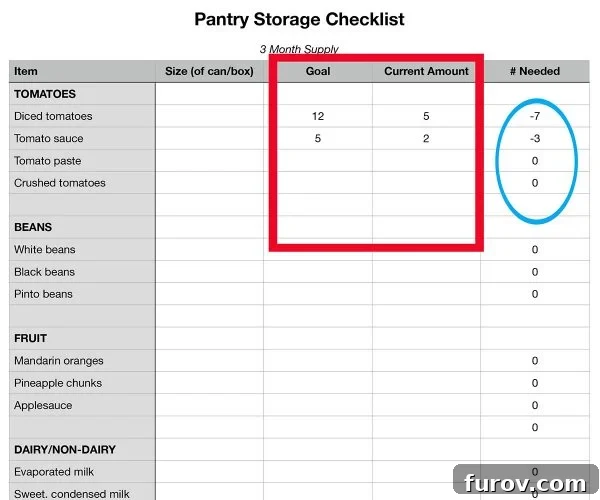
Both spreadsheets are intended for use on a computer, tablet, or any device where you can input numbers and calculate totals. They have not been formatted for optimal printing.
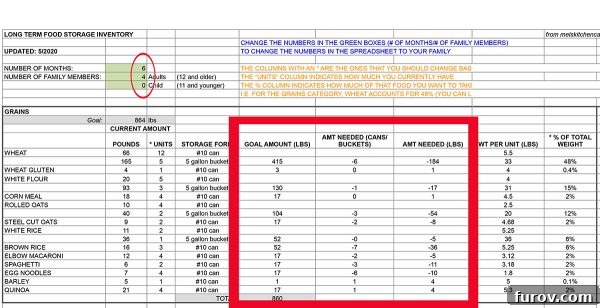
On the main food storage spreadsheet, you can easily edit the “# of months” and “# of family members” in the highlighted green rows. When you adjust these figures, all of the amounts in the subsequent categories will automatically update based on your new input:
- The goal amount for each food category, calculated in pounds.
- The quantity you still need to purchase or acquire, presented in two formats: pounds, and also in the number of cans, buckets, or bags, or whatever storage method you prefer.
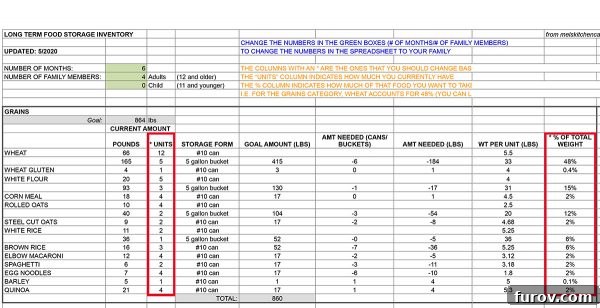
Furthermore, you have the flexibility to (and should!) customize the “Units” and “%” columns within the spreadsheet to perfectly align with your household’s specific requirements:
- Units: This column represents the quantity of each item you currently possess. When you modify the number in the “Units” column, the corresponding amount in pounds directly next to it will automatically update, giving you an immediate calculation of your current stock.
- % of Total Weight: Pay close attention here! The spreadsheet is organized into main categories such as Grains, Legumes, Dairy, etc. Changing the number of months and family members will adjust the total goal amount for each of these primary categories. These goal amounts are largely derived from a standard online food storage calculator (and you are absolutely welcome to modify them!). Within each main category, various food items contribute to that total. For example, in the “Grains” category, my storage includes wheat berries, white flour, corn meal, rolled oats, steel-cut oats, white rice, brown rice, and so forth. Based on our family’s consumption patterns, I assign a percentage to each of these in the last column. Because we frequently grind wheat and bake a lot of bread, wheat constitutes about 48% of our grains category. If your family doesn’t own a wheat grinder (or follows a gluten-free diet!), you’ll want to change that percentage to zero, or even better, input a food that you *do* eat and *do* wish to store.
Did that all make sense? Are you still with me? Tap, tap, is this thing on????
Feel free to experiment with it. Adjust the numbers, swap out foods, and truly make it your own. There are no copyrights or infringements; I’m offering this as a free resource for anyone who shares my love for detailed spreadsheets.
Do not let yourself be overwhelmed by what the spreadsheet might initially suggest you need to buy or what you seem to be lacking! Approach it with a sense of adventure. My strongest advice is to start by simply entering a bold, confident “THREE” in the “# of months” box and proceed from there. This manageable starting point will help build momentum without causing undue stress.
Download: Mel’s Food Storage Spreadsheet – EXCEL(includes both the long-term food storage and the pantry food storage) – UPDATED 5/16/20 to correct the “goal” formula
Download: Mel’s Food Storage Spreadsheet – NUMBERS(includes both the long-term food storage and the pantry food storage) – UPDATED 5/16/20 to correct the “goal” formula
Real-Life Application: My Living Food Storage System
As I emphasized at the beginning of this post, my food storage is a dynamic, “living” system that is actively used all the time. It’s not a static collection; it breathes, it changes, and it supports our daily lives.
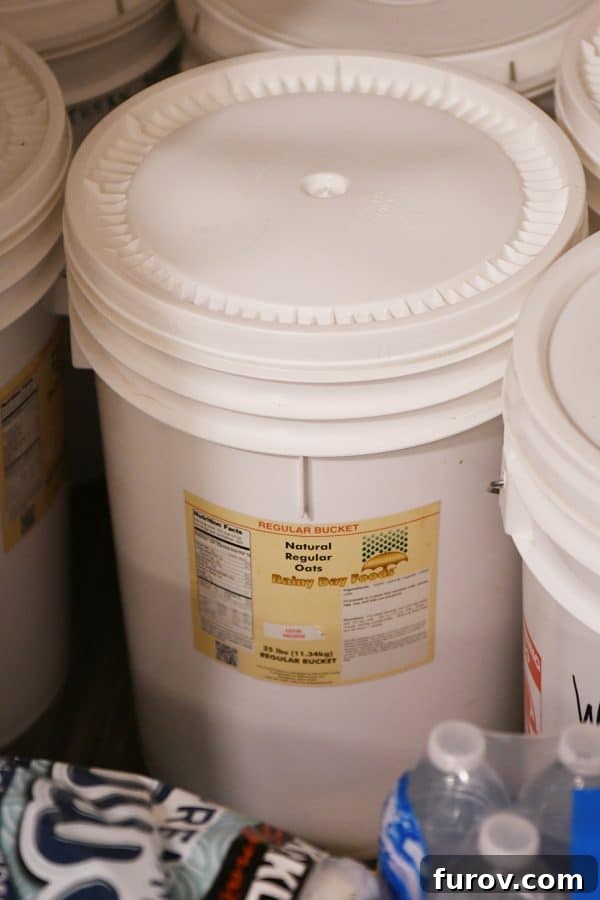
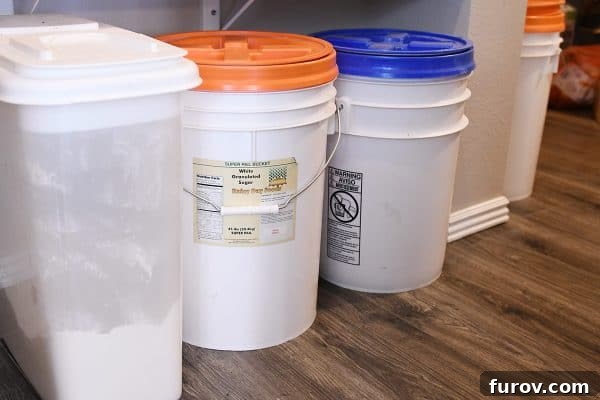
Yes, I do have several large buckets of natural rolled oats, granulated sugar, and hard white wheat neatly stacked in one of our designated storage areas (which we affectionately call “Hobbit Holes”). However, these are not dormant reserves. Every single one of them will eventually be rotated into our “Currently Being Used” status.
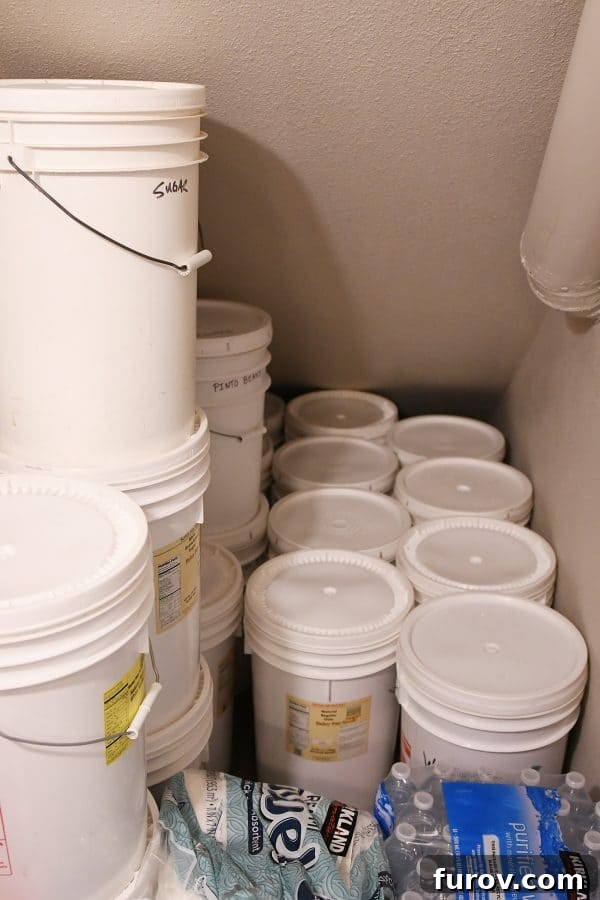
I aim to maintain approximately a 6-9 month supply of these core staples. Because I practice a consistent rotation method—using up the contents of one bucket before opening the next—these items are consumed and replenished long before they ever reach their expiration dates. This is the cornerstone of a truly living food storage system.
When a bucket or can is emptied, I diligently record it on my food storage tracking sheet. This ensures I remember to replenish it, though I typically order or purchase these larger staple items only once or twice a year, rather than immediately buying a new bucket or can the moment one is empty. This prevents overstocking and streamlines my bulk purchasing.
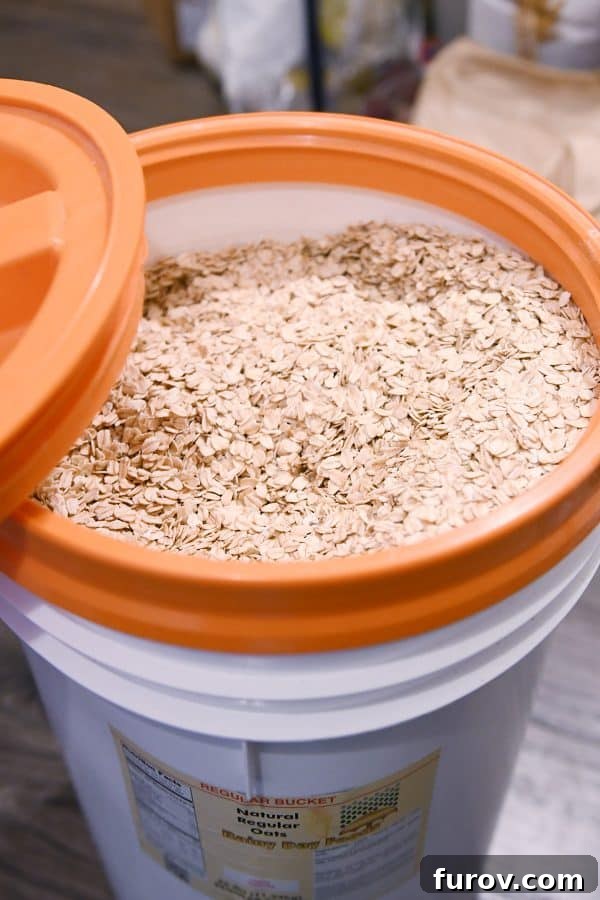
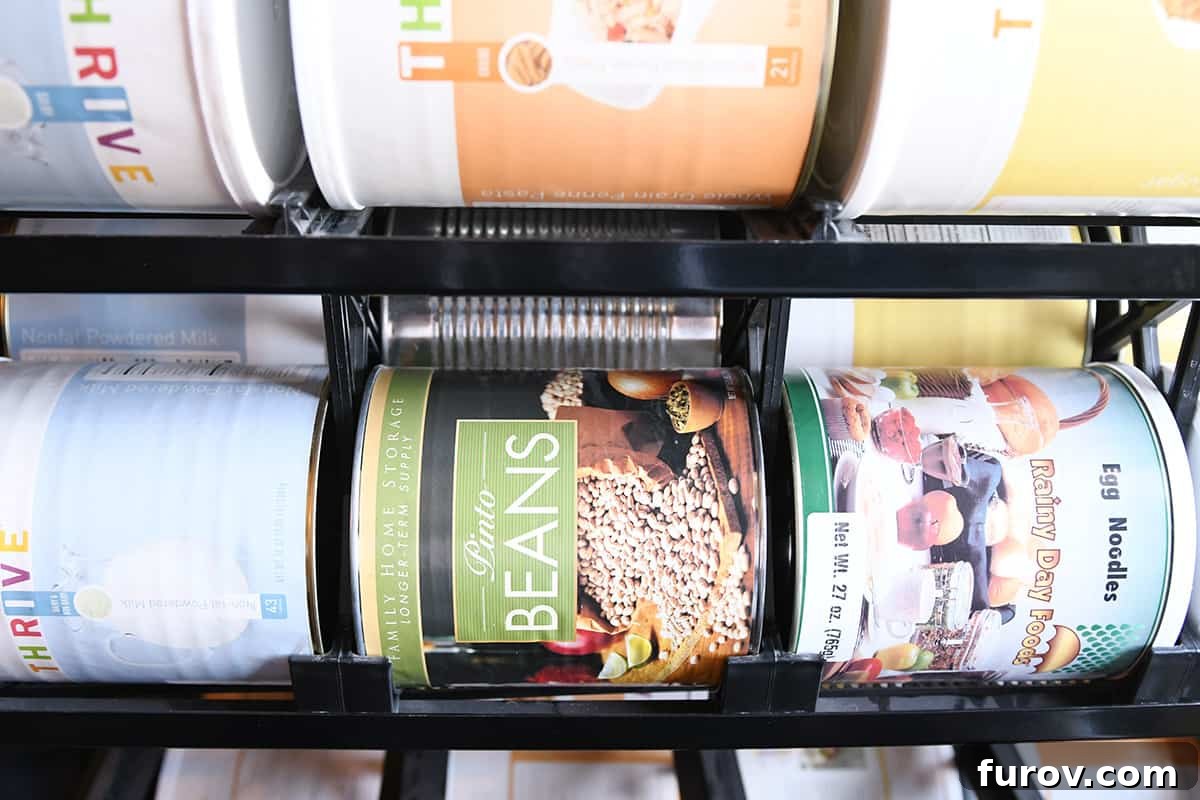
While 5-gallon buckets of food might not be a feasible option for every household, rest assured that you can apply the exact same principles using #10 cans or even smaller, more manageable packages. The core idea of rotation and strategic storage remains the same.
Conveniently, my pantry shelves are positioned at just the right height, allowing me to keep these 5-gallon buckets easily accessible. I enhance their usability by fitting them with handy twist lids (more on these useful accessories below!).
Utilizing Bulk Staples and Rotation
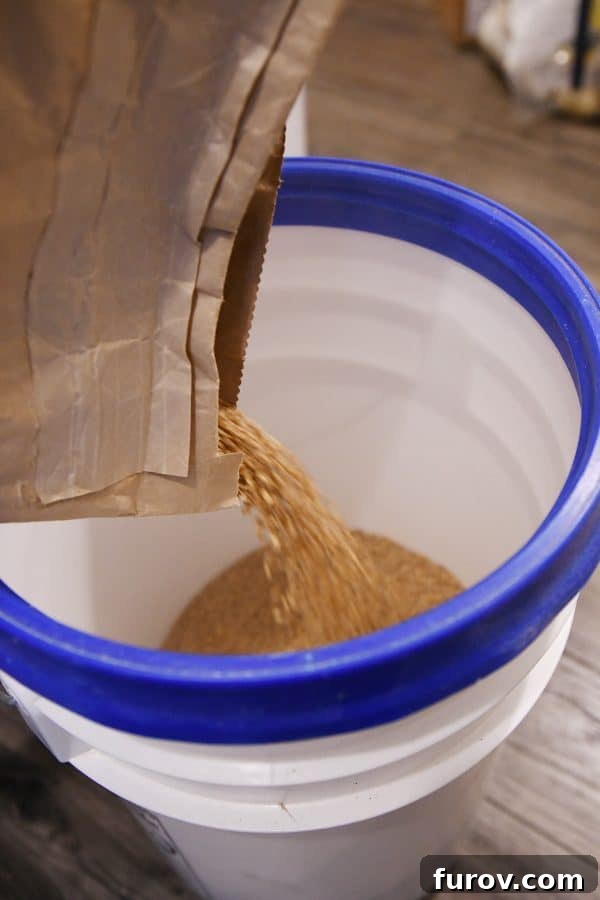
My wheat berries, sugar, and oats are all efficiently stored in these robust buckets. My white flour, meanwhile, resides in a huge rectangular container that I regretfully can’t source anymore (it was a lucky find at Sam’s Club about eight years ago). When a recipe calls for oats, I go directly to the bucket, scooping out what I need. Furthermore, if I find a good sale on a bag of wheat berries (or discover a new favorite like Einkhorn wheat berries, which I’ve been enjoying lately), I’ll often use it to refill an existing bucket of a similar staple before opening a brand new, sealed bucket. This strategy is smart because the bagged items typically have a shorter shelf life than sealed buckets, promoting optimal rotation.
Pantry Essentials: Canned and Dry Goods
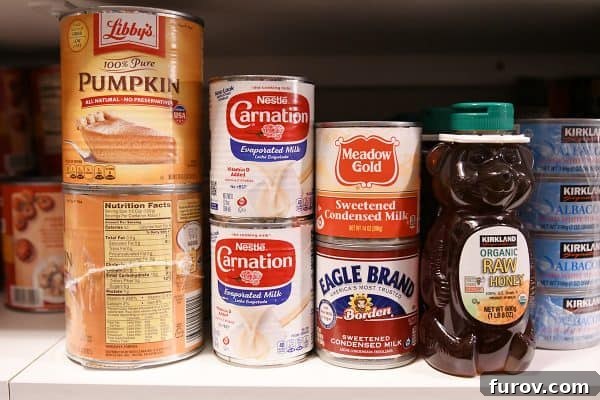
In addition to these long-term bulk staples, I also strive to maintain a readily accessible 3-month supply of canned goods and dry pantry items that we use regularly. While I don’t always religiously track every single one of these items on the Pantry Spreadsheet (which is included with the larger, comprehensive spreadsheet linked earlier), you certainly can if that level of detail suits you.
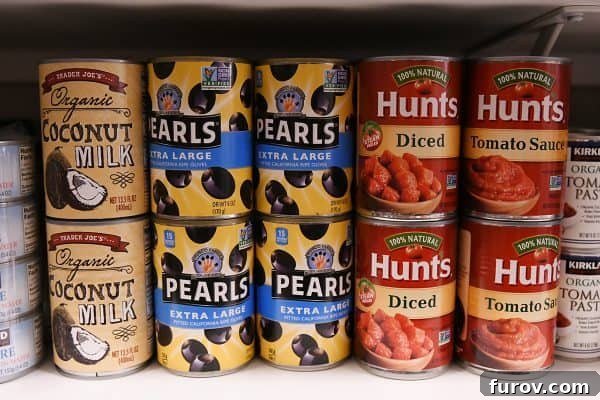
For me, I often just eyeball the dwindling space on a pantry shelf and instinctively know that it’s time to pick up some more diced tomatoes or black beans on my next Costco run. What specific canned and dry goods you stock on your pantry shelves will be entirely dependent on your family’s cooking habits, dietary preferences, and the number of people in your household. Customize this to fit your unique culinary landscape.
Maximizing Your Storage Space for Food Preparedness
Finding adequate space for food storage can present a significant challenge for many. Some may lack even a basic pantry, while others might be fortunate enough to have a spacious pantry, a dedicated cold storage area, and multiple closets. This wide disparity in living situations is precisely why the amount of food storage you accumulate and the methods you use are 100% dependent on your personal circumstances. The key is to do what you can, with what you have!
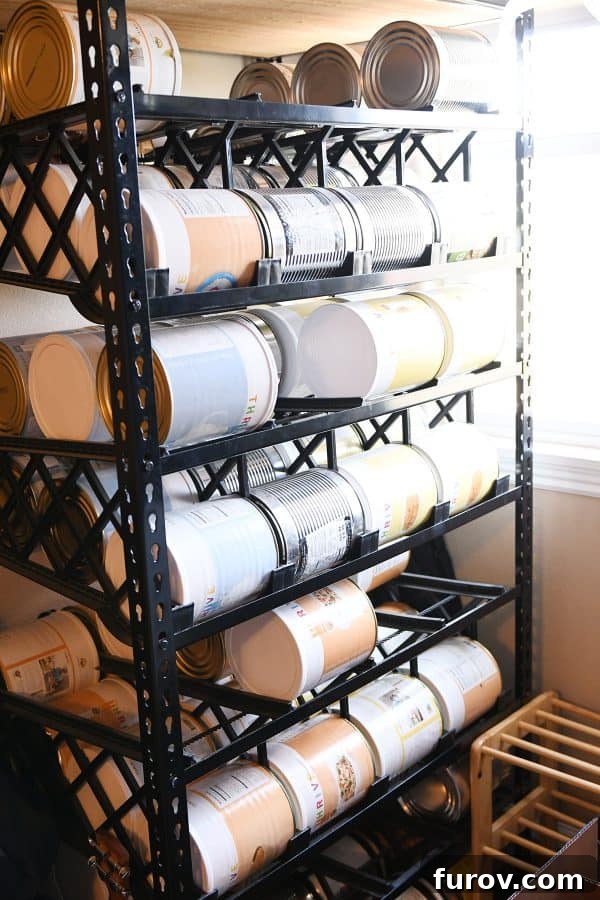
If food storage is a priority for you, cultivate creativity in identifying storage locations, even if they are outside the conventional kitchen area. Over the years, before I undertook a major renovation last year to expand my tiny pantry by knocking down a wall between the kitchen and garage, we ingeniously stored canned goods and other food items in various unconventional spots. These included under beds, on bedroom closet shelves, beneath staircases (our “Hobbit Holes”), and even in the garage (yes, despite the heat, which isn’t always ideal, but sometimes necessary!).
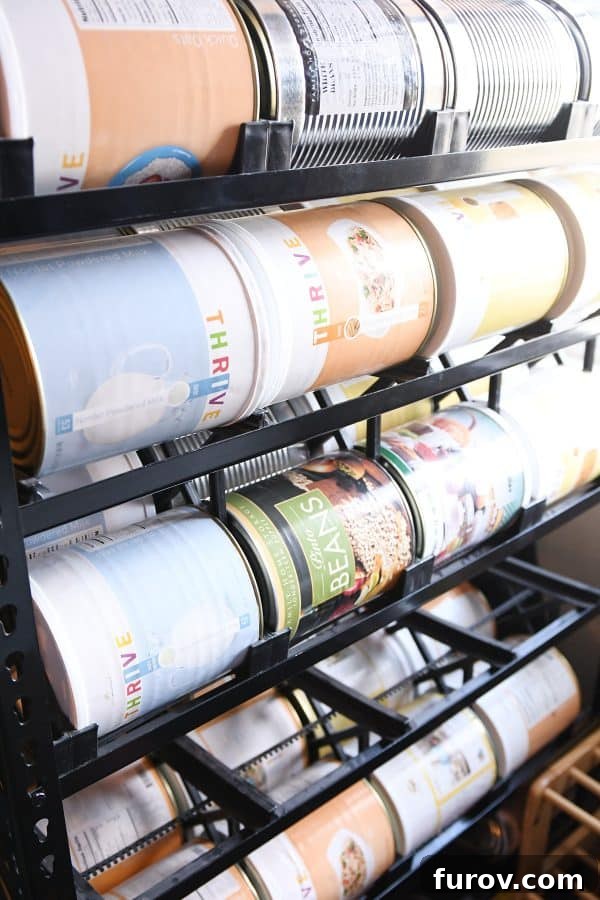
Currently, we even utilize a rolling food storage shelf that discreetly sits in the corner of one of our bedrooms. It might not be the most elegant solution, but it is highly functional and demonstrates that practical storage can be found anywhere.
Trusted Resources for Building Your Food Supply
For building a practical, everyday food supply, especially a one-to-three-month reserve, your local grocery store is often the best starting point. Pay close attention to expiration dates and thoughtfully consider how quickly your family will consume different foods to ensure proper rotation.
*UPDATED with additional links based on reader comments!*
- The Church of Jesus Christ of Latter-Day Saints Online Store: This offers a fantastic, budget-friendly option for essential staples packaged in #10 cans. Their products are available for convenient online purchase.
- Rainy Day Foods: This is perhaps my favorite go-to supplier for stocking up. They provide an extensive range of foods in various packaging options, including bags, buckets, super pails, and #10 cans. They also boast an impressive selection of gluten-free, non-GMO, and natural foods. For group orders, significant shipping discounts are available. Discovering I could get sealed cans of brown sugar (which I always run out of at the worst times!) from them was a game-changer.
- Emergency Essentials: Over the years, I’ve placed numerous orders with this company. They offer a diverse selection, particularly strong in freeze-dried fruits and vegetables, while also supplying essential basics.
- Azure Standard: I regretfully overlooked this excellent resource initially! Thanks to reader comments for reminding me. I used to order extensively from them. They are a phenomenal source for natural and organic bulk foods, often delivered through community drop points.
- Country Life Natural Foods: Another valuable discovery from reader feedback! This company appears to offer a wide array of high-quality health foods and natural ingredients at wholesale prices, with bulk purchasing options. I’m excited to explore their offerings further.
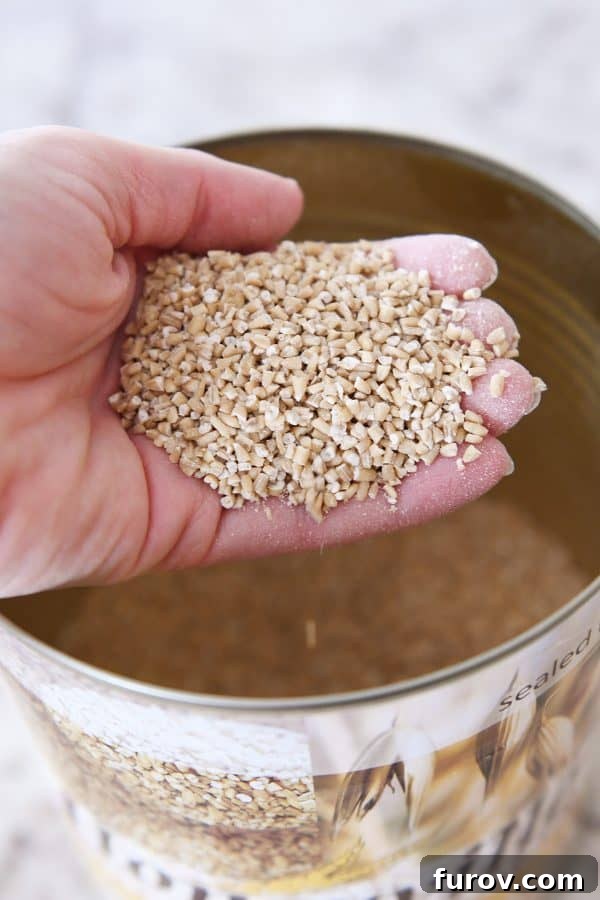
- Amazon: Reliable old Amazon remains a convenient source for a few specific favorites, such as Honeyville Steel Cut Oats and other niche staple ingredients that might be harder to find locally.
- Costco / Sam’s Club: Never underestimate the purchasing power of a good bulk foods retailer like Costco or Sam’s Club. These are my usual stops for stocking up on items like baking soda and baking powder. I decant a large bag of baking soda into a smaller container for my spice cupboard, as we use it quickly for baking, cleaning, and various household purposes. A large bag is highly practical for us, though it might not be for someone with lower consumption.
- Thrive Life: In the past, I ordered a lot of freeze-dried fruits and vegetables from Thrive Life. However, I must be candid: I’ve hardly used many of those purchases and now regret some impulsive stock-up decisions. Learn from my experience! It seems you either have a knack for integrating freeze-dried foods into daily recipes, or you don’t. I fall into the latter category for most items. We do enjoy their freeze-dried fruit for snacking and school lunches, so those are slowly being used up. However, I’ve decided to explore other fruit storage methods since freeze-dried options aren’t serving my long-term needs as expected. This company previously offered other excellent ingredients like quinoa and whole wheat pasta, but unfortunately, they appear to have shifted their focus almost exclusively to the freeze-dried sector.
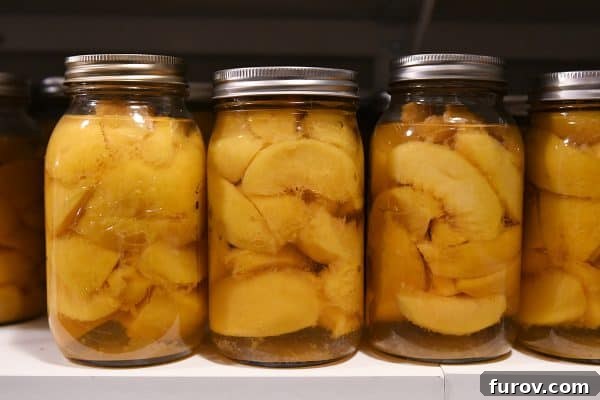
- YOU: Yes, you are potentially one of the greatest resources for your own food storage! Gardening and canning (or freezing your own fruits and vegetables) are incredibly rewarding and sustainable ways to build your supply. And without getting overly “Becky Home-Ecky,” canning simple items like peaches or preparing homemade jams and jellies is a fantastic and enjoyable way to incorporate fresh produce into your longer-term food storage. Just like all other aspects of my living food storage (I know, I sound like a broken record!), we consume our home-canned goods throughout the year and replenish them during peak canning season. If you think canning requires processing hundreds of jars at once, I encourage you to read this post on small-batch canning—it’s much more accessible than you might imagine.
- Local Resources: Don’t overlook the power of local farmers, community co-ops, and even specialized grocery stores as excellent sources for food storage and bulk items. For example, my local Winco store sells 25-pound bags of wheat berries (located near the coffee and peanut butter sections). I’ve also discovered several local farmers in southwest Idaho who offer buckets and bags of wheat, oats, and other grains. When I resided in Minnesota, there was an incredible Amish granary about an hour away that sold virtually any bulk item you could imagine. Ask around in your community; you might be pleasantly surprised by the valuable local resources you uncover!
Addressing Common Questions & Lingering Thoughts on Preparedness
- Do I store powdered milk? To be honest, beyond using it in some truly fabulous cookies, the thought of mixing it up to drink generally makes me gag (and I apologize to every grandmother throughout my lineage who is undoubtedly rolling in her grave right now). Could we manage to drink it if absolutely necessary? I’m confident we could. However, for our longer-term dairy needs, I prefer to store shelf-stable almond milk (which, like everything else, we use and rotate to prevent expiration), freeze-dried yogurt bites (one of the few freeze-dried foods we genuinely adore), and evaporated milk.
- Do I have a recipe book exclusively for “food storage recipes”? No, I do not. As I’ve emphasized repeatedly, my everyday life is my food storage, and my food storage is intrinsically linked to my daily life. I actively prepare all the recipes featured on my website using the staples from my food storage. This is precisely how I ensure continuous rotation. If we are ever “forced” to rely heavily on our stored provisions, I don’t want to pull out an unfamiliar book and hope that generic “food storage” recipes will work. Instead, I will confidently use the ingredients and recipes I’ve been utilizing successfully for years, tailoring them as needed to suit emergency situations, financial constraints, or the prevailing circumstances.
- Why do I store dry beans? Do I honestly cook with them? You absolutely bet I do! Thanks to the magic of the electric pressure cooker, transforming dry beans into perfectly cooked, ready-to-use beans is incredibly simple and quick. I think I would be perfectly content using them exclusively for these pressure cooker refried beans (they are SO incredibly good—and equally delicious made with pinto, black, or white beans). Their versatility and nutritional value make them a must-have.
- How do I store meat for food storage? This is an excellent and practical question! Our primary meat storage strategy revolves around a freezer full of beef, which we acquire from raising our own cows. This serves as a significant portion of our main meat food storage plan. However, I’m actually quite open to freeze-dried meat. While it might seem a bit unconventional at first glance, it performs exceptionally well in casseroles or skillet-based recipes, rehydrating nicely and adding essential protein. Consequently, I also keep a couple of #10 cans of freeze-dried chicken on hand as a supplemental option. Both Thrive Life and Emergency Essentials are reputable sources for freeze-dried meats.
- Storing water + other necessities: While I won’t delve into extensive detail about this in this particular post, storing water is an absolutely critical component of comprehensive food storage and emergency preparedness. Even simply having a case of bottled water on hand is vastly better than having nothing. We don’t possess massive barrels of stored water, but I did wisely invest in two excellent small water filters {aff. link} for ensuring access to safe drinking water. Beyond food and water, I also make it a point to maintain a reserve of essential medications, bandages, toilet paper (crucial, as we’ve all learned!), flashlights, batteries, and other non-food necessities. This topic alone could easily fill an entire separate post, but I wanted to briefly highlight its paramount importance here.
Additional Tools and Supplies for Your Food Storage Journey
- Gamma Seal Lids: These incredibly handy twist/Gamma seal lids, designed for 5-gallon buckets, can be readily found online (Amazon – aff link). I’ve also spotted them at brick-and-mortar stores like Home Depot and Winco (a regional grocery store in my area), and readers have mentioned finding them at places like Tractor Supply and farm implement stores.
- 5-Gallon Buckets: The essential 5-gallon buckets themselves are widely available at retailers such as Home Depot and sometimes Walmart (always double-check to ensure they are food-grade certified for safe food storage). They can also be purchased conveniently on Amazon (aff. link) or directly from food storage suppliers like Rainy Day Foods.
- Wheat Grinder: For those interested in whole-grain baking, investing in a wheat grinder is transformative. I have a comprehensive series of posts dedicated to grinding wheat at home. You can find a detailed guide on different types of wheat grinders and another on various types of wheat suitable for grinding. In brief, I almost exclusively use hard white wheat, though recently I’ve incorporated more Kamut and Einkhorn wheat berries, despite their higher cost. Crucially, wheat that is less than 3-5 years old (and properly sealed) will yield significantly better results than 30-40-year-old wheat, even if the latter has remained sealed. As for equipment, I’ve owned this KoMo Fidibus grain mill for a decade; I use it daily and cannot recommend it highly enough. It’s an exceptional machine, primarily used for grinding wheat, though I occasionally run rice through it for cleaning.

The true antidote to living in fear? It is, unequivocally, being prepared. Preparedness doesn’t just offer protection; it offers peace of mind.
Food storage doesn’t have to strictly conform to images of #10 cans and large white pails like those in my home. It certainly doesn’t need to last for a year or taste unappealing. It doesn’t require being 100% organic, and it can—and absolutely should—include beloved items like chocolate chips and fruit snacks, if those are items your family enjoys.
Ultimately, food storage is what YOU choose to make it. It functions effectively when it works specifically for YOU and your family’s unique lifestyle.
I understand this post has been extensive and perhaps a bit overwhelming in its detail. My sincere hope is that within this comprehensive guide, you’ll discover at least one valuable tidbit that significantly helps you on your personal food storage journey. And as always, I eagerly welcome YOUR ideas, insights, and feedback on all things related to food storage.
I genuinely love learning from your experiences and wisdom!
Alright, bye for now.