
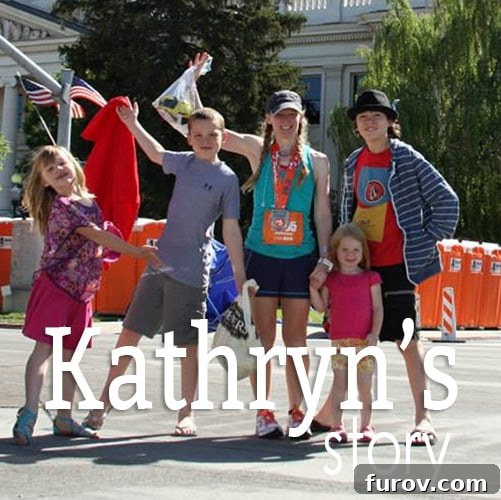
Welcome back to another inspiring running story that proves what dedication and an unwavering spirit can achieve! Today, we’re thrilled to feature Kathryn, a remarkable individual whose journey resonated deeply with us. Though we’ve never met her in person, her authentic, down-to-earth perspective as a “busy mom, not an athlete” – who, as you’ll soon discover, is quite an incredible athlete – is truly captivating. We extend our heartfelt thanks to Kathryn for sharing her experience. For more incredible running tales, you can explore all the other running stories here, and if you’re feeling inspired to share your own running adventures, you’ll find all the details on how to contribute here.

From Busy Mom to Boston Marathon Qualifier: Kathryn’s Inspiring Running Story
Dear fellow runners and dreamers,
My name is Kathryn, and like many of you, I’m just a regular homeschooling mom. With four vibrant children under my wing, my life is a whirlwind of lessons, laughter, and daily routines. Yet, amidst the beautiful chaos of family life, I nurtured a personal goal – one that seemed almost audacious for someone who never considered herself an “athlete.” This is my running story, a testament to what a determined spirit can achieve, even when juggling countless responsibilities and defying personal expectations.
The Reluctant Runner: A Mother’s Journey Begins
From Casual Jogs to Lofty Goals
My serious engagement with running began after the birth of my fourth child in 2010. Before then, running was a sporadic activity, a way to clear my head or get a quick workout in. If I managed to run three miles, I considered it a successful outing and felt a significant sense of accomplishment. The idea of tackling a 10K race felt like an enormous undertaking, a challenge reserved for truly dedicated runners. As for half marathons or full marathons? Those distances seemed utterly superhuman, a feat only achievable by an elite few with exceptional athletic prowess and endless training hours. I certainly didn’t see myself in that league, nor did I aspire to be. My life was about my family, not competitive running.
The Marathon Dream Takes Hold
Then, fate intervened in the form of a new friend – a running friend. Her passion and confidence were infectious. She looked at me, a busy mom of four, and saw a marathoner. My initial reaction was an unequivocal, “No way!” The thought felt preposterous. However, her persistence chipped away at my self-doubt. Reluctantly, I agreed to attempt a half marathon, which I successfully completed in 2012. That accomplishment, while significant, still didn’t extinguish her belief in my full marathon potential. She kept encouraging, kept pushing, until I finally conceded. A full marathon. The decision felt monumental, even a little crazy. “What was I thinking?” I often asked myself. “I’m a busy mom with endless responsibilities, not a serious athlete.” This internal dialogue, a constant companion throughout my journey, became both a challenge and a motivator, pushing me to redefine what I thought was possible for myself.
Conquering the First 26.2: Lessons from Shiprock
Overcoming Obstacles and Embracing the Challenge
My inaugural marathon experience took place in May 2013, amidst the stunning yet challenging landscape of Shiprock, New Mexico. The race was an unyielding test of endurance and resolve. The weather was oppressively hot, the sun beating down relentlessly, transforming each mile into a grueling battle against the elements. It was incredibly hard, pushing my physical and mental limits to their absolute breaking point. I vividly recall making multiple, desperate bathroom stops, each one eating into my time and disrupting my rhythm. Adding to the agony, my IT band began to ache severely, a sharp, persistent pain that made every step a struggle. There were moments I truly believed the finish line would never appear, that this arduous journey would simply never end. I kept repeating to myself, “Just keep moving.” But I pressed on, one agonizing step after another, until I stumbled across the finish line in 4 hours and 24 minutes. My immediate, unfiltered thought was, “I am NEVER doing that again.” Yet, something remarkable happened that very evening. Despite the pain, the exhaustion, and the initial vow, I found myself inexplicably drawn to the internet, already searching for my next marathon. The seed had been planted; the challenge, once met, now beckoned again, promising a different, perhaps better, experience.
The Boston Dream: A New Ambition Emerges
My post-Shiprock search quickly led me to the Utah Valley Marathon. The race slogan, “Pain you Enjoy!” ironically resonated with my newfound, somewhat masochistic, appreciation for the marathon distance. This time, my ambition had grown exponentially. Merely finishing was no longer enough. I set my sights on a far loftier goal: qualifying for the Boston Marathon. It felt like an audacious leap, especially for someone like me. I had no history of competitive sports – no track team experience, no cross-country accolades, no background in any organized team sport whatsoever. I was simply a mom of four, with children ranging in age from 3 to 13, navigating the daily demands of family life. Yet, the dream of Boston, the pinnacle for so many amateur runners, had firmly taken root, a symbol of defying personal limitations.
Strategic Training with the Hanson’s Plan
To achieve this monumental goal, I chose to follow the rigorous Hanson’s Marathon Method training plan. This plan, known for its high mileage and cumulative fatigue approach, demanded significant dedication. The weeks of training were intense but largely successful, systematically building my strength and endurance. I meticulously followed the schedule, balancing long runs, speed work, and tempo runs with the endless duties of homeschooling and motherhood. However, the delicate balance of marathon preparation was disrupted during the crucial taper phase when I was struck down by the flu. The illness left me feeling utterly drained, my body trashed and my energy levels plummeting just when I needed to feel fresh. This physical setback, coupled with the inevitable “taper insecurities” that plague many runners, led to a period of intense self-doubt. My heart was fiercely set on achieving a Boston Qualification (BQ), but I found myself reluctant to voice this aspiration to others, fearing the sting of potential failure. I had meticulously chosen a goal pace that would give me a comfortable ten-minute buffer under the BQ standard for my age group. Yet, as race day drew near, every doubt imaginable crept in. I questioned every long run, every speed workout, convinced I had somehow missed something vital in my 18 weeks of preparation. I constantly worried, “Did I train hard enough? Am I strong enough to maintain this pace for 26.2 miles?” The mental battle felt as grueling as any physical training.
Navigating Pre-Race Jitters and Logistics
June 14, 2014, dawned with a mixture of excitement and trepidation. My incredibly supportive husband and our four children embarked on a six-hour drive north from Colorado to Utah, a journey of shared anticipation that added a layer of family adventure to my personal quest. The evening before the race followed a familiar, comforting ritual: a pre-race dinner of spaghetti, designed to carbo-load and fuel my body. Afterward, my husband, understanding my need for quiet focus, took the kids swimming at the hotel. This allowed me precious, uninterrupted time to organize all my race essentials, meticulously laying out every piece of clothing and equipment. My primary goal was to get to sleep early, hoping for a deep, restorative rest. However, as soon as the lights were out, my spirited three-year-old daughter found a surprising second wind, repeatedly getting out of bed and disrupting the quiet. I felt a surge of panic, a desperate fear that I would never fall asleep, that all my meticulous planning might be undermined by a restless toddler. The delicate balance of motherhood and marathon prep was never more apparent than in those fleeting, anxious hours.
Race Day: Utah Valley Marathon – A Battle of Will
Early Morning Preparations and the Calm Before the Storm
I finally succumbed to sleep in fits and starts, waking definitively at 2:30 AM. Despite setting three alarms, I had spent much of the night tossing and turning, irrationally convinced I would somehow miss them. My immediate priority was to remain calm, to not let the fragmented sleep add another layer of stress. I rose quietly, making my way through the dark hotel room while my husband and children remained sound asleep. I forced down three packets of oatmeal, mixed with hot water from the tap since my room lacked a microwave, alongside my iced latte, purchased the night before and kept perfectly chilled in the hotel ice bucket. Every item for the race was laid out, a precise arrangement designed to minimize fumbling and prevent any accidental awakenings of my youngest. At 3:30 AM, I slipped out of the room, stepping into the cool, dark pre-dawn air. A long line of buses, silent and imposing, awaited me, their headlights piercing the darkness. Dressed in old, paint-splattered sweatpants, a thick, cozy hoodie, and clutching a fleece blanket, I boarded, ready for the solitary journey to the starting line, preparing myself mentally for the immense challenge ahead.
The Starting Line: Embracing the Energy
By approximately 4:30 AM, I arrived at the starting line, a hub of hushed activity and anticipation. The air was crisp, and the atmosphere was made cozy by numerous campfires, their flames dancing against the pre-dawn sky, casting long shadows. I had felt a little self-conscious carrying my oversized fleece blanket, worried I looked like a dork amidst serious runners, but my gratitude for it quickly overshadowed any embarrassment. Runners huddled everywhere, wrapped in blankets, sleeping bags, and even old bathrobes – a brilliant idea, I noted! I rolled myself into a snug burrito on the ground, pulled my hoodie over my head, and managed to doze for another precious hour. It was surprisingly peaceful under the vast, star-studded sky, a serene calm before the impending storm of the marathon, a moment of profound quiet before the intense physical and mental exertion.
Before I knew it, the quiet stillness gave way to a surge of energy. It was time to make my way to the starting corrals, a sea of anxious and excited faces. As the official gun boomed, signaling the commencement of the race, I tossed my comforting blanket onto a nearby fence, a symbolic shedding of pre-race nerves, and began my run, a small wave in a much larger current of determined athletes.
Pacing Challenges and Self-Doubt on the Course
The Utah Valley Marathon was a vastly different experience from my first attempt in Shiprock. Here, the sheer volume of runners created an electric atmosphere, a palpable sense of shared purpose and excitement that fueled my initial miles. However, an early technical glitch with my Garmin watch introduced an unexpected layer of stress. Initially, it displayed a pace of “10-something,” which felt inaccurately slow given my perceived effort. Doubting the device and my own perception, I pushed on, only for it to register an 8:40 minute-mile at the first marker. “Hmmmm…,” I thought, a flicker of panic. My aggressive A-goal pace for a BQ was 8:35. Then, over the next two miles, the Garmin wildly swung in the opposite direction, showing times in the 7:xx range. Now, I was truly freaked out. I didn’t feel like I was flying that fast. Too slow, then too fast – I couldn’t trust my Garmin, and by extension, I began to lose trust in my own body’s signals. I consciously tried to slow my pace, relaxing, and focusing on deep, controlled breathing, but the watch stubbornly remained in the 7-minute range. I truly believed I couldn’t go any slower without walking. To my astonishment, those chaotic miles ended up being 7:31 and 7:35. I was genuinely shocked by these numbers and, recognizing the risk of burning through my glycogen stores too early, became hyper-focused on reining in my pace. These speeds were simply not typical for my marathon strategy, and maintaining them would jeopardize my entire race plan.
The Course Unfolds: Beauty, Hills, and Headwinds
Despite the early pacing drama, the first half of the race unfolded remarkably smoothly. Much of it passed in a blur of focused effort, with only fleeting memories of enjoying the graceful rolling hills and the breathtaking beauty of the course. There were indeed some strong headwinds, which added another layer of resistance, but my mood remained unexpectedly cheerful, buoyed by the stunning scenery and the collective energy of the runners. The course itself was undeniably gorgeous, living up to its reputation for a significant downhill elevation profile, a feature I had specifically sought out for its BQ potential. However, the elevation map hadn’t fully conveyed the numerous rolling hills peppered throughout the route. While challenging, these undulations provided a welcome, albeit strenuous, break for my quadriceps, engaging different muscle groups and offering a momentary reprieve from constant downhill pounding. Living at 7200 feet in the mountains, I felt a distinct advantage; the altitude and hills of the Utah Valley course were not vastly different from the terrain I trained on daily, allowing me to feel more at ease than many other participants, a small but significant comfort.
Powering Through with Music and Determination
As I reached the 13-mile mark, the halfway point, I cued up my iPod playlist. This wasn’t just any playlist; it was a surprise compilation my thoughtful husband had curated for me, based on some general parameters I’d given him. It was absolutely perfect – a collection of super happy, upbeat songs that managed to evoke both laughter and tears of sheer joy. It even included some delightfully corny tunes from my childhood, like the theme songs from “Happy Days” and “Laverne & Shirley,” specifically chosen to make me smile and forget the burgeoning fatigue. At this point, my fueling and hydration strategy was going well, and I felt strong and optimistic. This feeling of well-being persisted until around mile 16, when a familiar and unwelcome problem resurfaced, threatening to derail my meticulously planned race.
Pushing Through the Wall: Grit and Resilience in the Final Miles
Battling Physical and Mental Hurdles
Despite taking Imodium before the race, my recurrent stomach issues began to plague me again at mile 16. My first marathon a year prior had been punctuated by frequent pit stops, and the dread of a repeat performance loomed large. Fortunately, a porta-potty appeared at precisely the right moment, allowing for a quick, if frustrating, stop. The result was a noticeable slowdown in miles 16 and 17, a loss of precious time that was incredibly disheartening. The challenge escalated further at mile 20. Another urgent need for a porta-potty hit me, a truly rapid situation that required immediate attention to avoid an embarrassing mishap. Thankfully, I was once again right at one, and to my immense relief, there were no lines. More time lost, but averted disaster. Simultaneously, my IT band, which had been a nuisance during my first marathon, began to flare up with renewed intensity. It felt as though everything was starting to unravel, a cruel unraveling in the critical final stretch of the race. The pain in my IT band persisted, relentlessly accompanying me to the very end, each step a testament to my determination to keep going.
By mile 21, the thought of another gel was repulsive. My stomach churned at the idea. I needed something different, something real. Spotting a banana at an aid station, I grabbed it, smashing the fruit in my hand and consuming it like a makeshift gel. Banana was smeared down my arm and leg – I was a mess, but honestly, at that point, I simply didn’t care. I was beyond caring about appearances or minor inconveniences; my entire focus was on moving forward, on fueling my body for the remaining brutal miles.
The Unwavering Support of Family
A much-needed boost arrived at mile 22. There, my incredibly supportive husband and our four children were waiting, their enthusiastic cheers a beacon of hope and love. Their familiar faces and shouts of encouragement were like a powerful shot of adrenaline. My husband, ever the encourager, even ran alongside me for a short stretch, offering words of encouragement and a familiar presence. I was so utterly exhausted that I couldn’t even manage to speak, my lungs burning with every breath, but their presence was a powerful, silent affirmation that kept me going, a profound reminder of the “why” behind all the effort and sacrifice. They were my inspiration, pushing me when my own reserves felt depleted.
The Final Push: Doing the Math and Digging Deep
The final miles, 24, 25, and 26, blurred into an agonizing continuum. I began to question if this race would ever truly end. I felt as though I had given every ounce of energy, pushed beyond every limit, and a terrifying thought crept in: had I pushed too much? Would I collapse before the finish line? The wheels truly felt like they were falling off, each muscle screaming in protest. During these grueling last five miles, my mind desperately tried to perform complex mental math, calculating whether a Boston Qualification was still within reach. In my state of extreme fatigue and despair, my calculations were off; I couldn’t concentrate properly and convinced myself it was too close, that I had likely fallen short. Despair began to set in, heavy and persistent. Yet, amidst the pain and doubt, an inner voice urged me to dig deeper, to leave absolutely everything I had out on the course. I repeated a mantra to myself: “If it was easy, everyone would be doing it.” I tried to talk myself into being strong, to harness a strength I wasn’t sure I still possessed, drawing on every ounce of mental fortitude.
Triumphant Finish: A Dream Realized
Overwhelming Emotion and the Sweet Taste of Success
The last three miles, though excruciating, saw me pushing below my initial goal pace, fueled purely by a raw, unyielding will. I had nothing left in the tank but the sheer determination to reach that line, to see what was truly possible. And then, it happened. I crossed the finish line with a time of 3:45:23, a staggering 9 minutes and 37 seconds under the Boston Qualification standard for my age group. The moment the weight of that accomplishment hit me, I couldn’t help it; the tears just started flowing. Sobs burst from deep within me, an overwhelming release of emotion after months of training, self-doubt, and physical exertion. I found my husband in the post-race crowd and simply collapsed into his arms, sobbing uncontrollably. He, sweet man, mistakenly thought my tears were tears of disappointment, believing I hadn’t qualified. But oh, how wrong he was! I had qualified, and by a significant margin! My tears were not of failure, but of an immense, beautiful culmination – the profound realization of a dream, the validation of every sacrifice, every painful mile. I believe any runner, any person who has pushed themselves to achieve a seemingly impossible goal, truly understands that overwhelming mix of relief, joy, and exhaustion, a feeling that words can barely capture.
Reflecting on a Journey of Transformation
After ringing the triumphant PR bell and proudly receiving my coveted BQ shirt – a special emblem given by the race to those who qualify for Boston – we headed back to the hotel. A well-deserved soak in the hot tub, while the kids splashed happily in the pool, provided much-needed relief for my aching muscles, a luxurious reward after hours of relentless pounding. My family, celebrating my achievement, had thoughtfully purchased a decadent chocolate éclair for me. It took about an hour for my stomach to settle enough to enjoy it, as the initial post-race nausea was still potent. That incredible day was seven months ago, a turning point that forever altered my perception of my own capabilities and instilled a deep sense of accomplishment. It wasn’t just a race; it was a journey of self-discovery.
Kathryn’s Enduring Message: You Can Do Anything
And so, here I am today, in January 2015, back in full training mode for my third marathon. But this time, it’s different. This time, I’m not just running to finish, or even to qualify; this time, I’m going to Boston. My journey serves as a powerful reminder: never say never. There was a time when the Boston Marathon felt utterly unattainable, a dream reserved for others, a distant possibility. I truly believed it would never be “in the cards” for a person like me – a normal person, a simple stay-at-home mommy. But my experience has taught me that labels and perceived limitations are just that: perceptions. With a clear goal, unwavering determination, and the courage to pursue it, you truly can achieve anything you set your mind to, no matter your background or current circumstances. My story is not unique in its challenges, but it is unique in its outcome for me. If I, a busy homeschooling mom with no athletic background, can achieve this, then imagine what you can accomplish when you dare to dream big and commit to the journey.
You can do it. Believe in yourself, set your goal, and go for it with all your heart. The finish line, whatever your goal may be, awaits your courage.
Warmly,
Kathryn