
Conquering the Half Marathon: My Personal 20-Week Training Journey
The exhilarating challenge of a half marathon often sparks curiosity and ambition, even among those who don’t identify as natural runners. Following my recent announcement about tackling an upcoming half marathon, many of you reached out, eager to understand the training schedule I’ve chosen for this significant undertaking. While the path to 13.1 miles can seem daunting, I’m excited to share my personalized approach, designed with flexibility and realism in mind, especially for a self-proclaimed “non-runner.”
A Quick but Crucial Disclaimer: I am not a certified personal trainer, a medical doctor, or an expert in exercise physiology. The insights and training plan shared here are based on my personal research and experience. It is paramount that you exercise your own best judgment when selecting any training program for running, or any exercise regimen for that matter. Prioritizing your health and preventing injury should always be your top concern. Please, listen intently to your body, and do not hesitate to consult a physician or a qualified running coach if you have any questions or concerns. Your well-being comes first!
Crafting My Ideal Half Marathon Training Program: Key Criteria
When I first started researching half-marathon training programs, I had a very specific set of criteria that guided my search. As someone not inherently inclined towards running, these factors were critical in finding a plan that felt achievable, sustainable, and motivating. It wasn’t about finding the ‘perfect’ plan endorsed by elite athletes, but rather the ‘perfect-for-me’ plan that fit my life and capabilities.
- A Generous 19-20 Week Training Window: My philosophy is to start early and build gradually. Even though the race isn’t until June, I decided to begin now. As an official “non-runner,” I openly admit that I need a longer, more gradual buildup to avoid injury and burnout. This extended timeframe allows for a lower initial mileage, ample rest, and flexibility for missed days without derailing the entire program. It also provides a significant psychological advantage, knowing I have plenty of time to adapt and improve without feeling rushed.
- A Realistic Schedule: Maximum Four Running Days a Week: My life is already packed with family responsibilities and other commitments. Dedicating six days a week to running simply wasn’t feasible, nor was it desirable. I knew that pushing myself to run too frequently would lead to exhaustion and a quick loss of motivation. My goal was to find a program that maximized impact with fewer running days, allowing for adequate recovery and preventing running from becoming a chore rather than an enjoyable challenge.
- The Psychological Edge: Running Beyond 10 Miles in Training: Most conventional training wisdom suggests that you don’t *need* to run more than 10 miles in training to complete a 13.1-mile race. However, my somewhat detail-oriented brain doesn’t quite work that way. I vividly imagine hitting the 10-mile mark on race day, realizing I’ve never run farther, and potentially shutting down mentally. To preempt this psychological barrier, I specifically sought a program that would push my longest training run past the 10-mile mark. It might seem “slightly crazy” to some, but for me, that extra mileage in training is about building crucial mental fortitude and confidence for race day.
- Accessibility and Affordability: Utilizing Free Resources: In today’s digital age, there’s an incredible wealth of free, high-quality running resources available online. I saw no need to invest in a paid training schedule when so many reputable and effective plans are freely accessible. My aim was to synthesize the best elements from various free programs into a custom plan that met all my criteria, proving that achieving a significant running goal doesn’t have to come with a hefty price tag.
My Personalized 20-Week Half Marathon Training Schedule
After sifting through countless websites dedicated to running, training, and half marathons, I synthesized the elements I liked best from various schedules to create a basic outline tailored specifically for me. This personalized plan focuses on sustainable progress and essential flexibility, acknowledging the realities of a busy life.
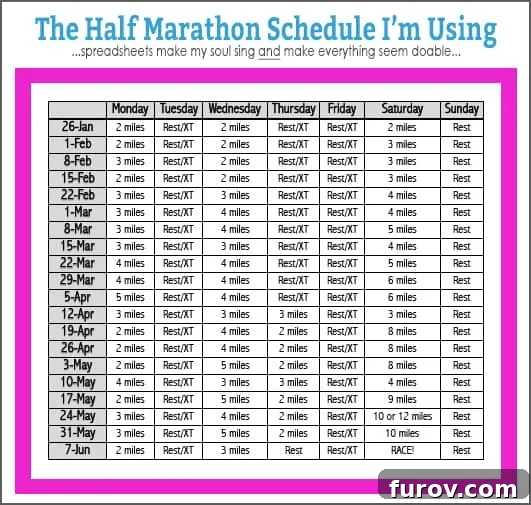
Download Editable Excel File | Download PDF Printable File
For the initial 12 weeks of this program, my commitment will be to run three days a week. As my endurance builds and my body adapts, I aim to increase this to four days a week if feasible. Sundays are sacred for me – they are 100% designated rest days, essential for physical and mental recovery. On the other days marked as “Rest/XT” (cross-training), I’ve built in flexibility, allowing me to gauge how my body feels. This design gives me three buffer days in the plan. If I need an extra rest day, I have other opportunities to incorporate a cross-training workout.
For me, cross-training will primarily involve strength training. This is a crucial component often overlooked by beginner runners. Strengthening the muscles around my knees, ankles, and in my core is vital for preventing common running injuries, improving running form, and boosting overall endurance. I am not planning on the intense, six-day-a-week exercise, running, and general stress often associated with serious training. That approach simply isn’t sustainable for me. However, consistently running three times a week, complemented by targeted strength workouts, provides a solid and achievable foundation for success.
This schedule feels genuinely “doable” for me!
<– That’s me embracing a positive mindset during the first week, perhaps still in a blissfully naive state, but optimistic nonetheless.
Essential Tips for Beginner Half Marathoners: Beyond the Schedule
Embarking on a half marathon journey involves more than just following a running schedule. For beginners, understanding these additional elements can significantly enhance the training experience and improve the chances of a successful race day.
Listen to Your Body: The Golden Rule
This cannot be stressed enough. There’s a fine line between pushing yourself to improve and pushing yourself to injury. Learn to differentiate between muscle soreness (which is normal) and sharp, persistent pain (which warrants rest or professional advice). Fatigue, sleep disturbances, and a drop in performance can all be signs of overtraining. Don’t be afraid to take an extra rest day or adjust your mileage if your body is signaling distress. Consistency over intensity is key for long-term progress.
Patience and Consistency: A Marathon, Not a Sprint
Progress in running is rarely linear. There will be days when runs feel effortless, and others when every step feels like a struggle. Embrace both. The most important thing is showing up consistently. Small, consistent efforts over weeks and months will lead to remarkable improvements in endurance, speed, and mental toughness. Avoid comparing your progress to others; focus on your own journey and celebrate every milestone.
Invest in Proper Gear: Your Foundation for Comfort and Performance
While you don’t need to break the bank, investing in a few key pieces of gear can make a world of difference.
- Running Shoes: The single most important piece of equipment. Visit a specialized running store where experts can analyze your gait and recommend shoes suitable for your foot type and running style. Replace your shoes every 300-500 miles to prevent injuries.
- Moisture-Wicking Apparel: Ditch cotton, which holds sweat and can cause chafing. Opt for synthetic fabrics that wick moisture away from your skin, keeping you dry and comfortable during your runs.
- Hydration Belt/Bottle: For longer runs, carrying water is essential, especially as the weather warms up. Experiment with different options to find what works best for you.
Nutrition and Hydration: Fueling Your Body
What you eat and drink profoundly impacts your energy levels and recovery.
- Pre-Run: Aim for easily digestible carbohydrates about 1-2 hours before a run. Think a banana, toast, or oatmeal.
- During Run (Long Runs): For runs over 60-75 minutes, consider carrying fuel like energy gels, chews, or fruit to replenish glycogen stores. Practice with these during training to avoid stomach issues on race day.
- Post-Run: Within 30-60 minutes after a run, consume a mix of carbohydrates and protein to aid muscle repair and glycogen replenishment.
- Everyday Hydration: Drink water consistently throughout the day, not just around your runs. Staying well-hydrated is crucial for overall health and athletic performance.
Warm-up and Cool-down: Non-Negotiable Rituals
Before each run, dedicate 5-10 minutes to a dynamic warm-up (e.g., leg swings, arm circles, high knees) to prepare your muscles and joints. After your run, spend 5-10 minutes cooling down with a brisk walk, followed by static stretches (holding stretches for 20-30 seconds) to improve flexibility and aid recovery.
Mental Preparation: The Unsung Hero of Endurance Running
A half marathon is as much a mental challenge as it is a physical one.
- Visualization: Spend time imagining yourself successfully completing your runs and crossing the finish line on race day.
- Break It Down: During tough runs or the race itself, break the distance into smaller, manageable chunks (e.g., “just get to the next lamppost,” “run for five more minutes”).
- Positive Self-Talk: Challenge negative thoughts and replace them with empowering affirmations. Remind yourself of your training and strength.
Exploring Alternative Half Marathon Training Plans
While my schedule is tailored to my specific needs, I understand that one size doesn’t fit all. Many excellent free resources offer different approaches to half marathon training. Here are a few that stood out during my research, catering to various starting points and preferences:
The “Couch-to-Half-Marathon” Approach
My cousin, Alex, who is also running this race and shares a similar starting fitness level, discovered a fantastic Couch-to-Half-Marathon schedule. This type of plan is ideal for absolute beginners who might be starting from very little running experience. Its core philosophy often centers less on pure mileage and more on building time and endurance through gradual progression. These plans frequently incorporate walk/run intervals, strategically designed to gently introduce your body to running longer distances, eventually preparing you to run the entire race without stopping. They prioritize making running accessible and enjoyable from day one.
Walk/Run Programs for the Half Marathon
For those who expressed interest in participating in a half marathon but prefer a walk/run strategy, there are dedicated programs available. A quick Google search for “half marathon walk run programs” will yield numerous ideas. Two particularly prominent and well-regarded options include:
- Hal Higdon’s Walking Half-Marathon Training Program: Hal Higdon is a renowned figure in the running world, and his 12-week walking half-marathon program is an excellent choice for those who want to experience the distance without the continuous running commitment. This program is meticulously structured, guiding walkers through a progression that builds endurance and prepares them for the full 13.1 miles at a walking pace. It emphasizes fitness and completion, proving that you don’t have to be a runner to be a half marathoner.
- Jeff Galloway’s Beginner Walk/Run Half Marathon: Jeff Galloway is famous for his “run/walk/run” method, which advocates for strategic walking breaks to conserve energy, reduce fatigue, and prevent injuries. His Beginner Walk/Run Half Marathon plan is highly popular, especially for those looking to finish strong and potentially avoid common runner’s aches and pains. On the Runkeeper page, simply click on “Schedule” on the left, and each day’s workout on the calendar is clickable, providing detailed instructions on the exact run/walk intervals and duration for that day.
Your Journey to the Finish Line
Embarking on a half marathon journey is a truly personal and rewarding experience. Whether you choose a rigorous running schedule, a flexible run/walk approach, or a dedicated walking program, the most important step is to commit and find a plan that resonates with your goals and lifestyle. Remember the joy of movement, the pride in your progress, and the incredible feeling of accomplishment that awaits at the finish line.
Many of you possess far more running experience than I do, having conquered countless miles and races. I wholeheartedly encourage you to share your wisdom! Please feel free to chime in via the comments section below with insights on the training programs you’ve used, any helpful tips, motivational strategies, or gear recommendations. Your collective experience is invaluable to aspiring runners and provides a supportive community for all of us on this exciting journey!