
Mastering the Art of Pineapple Preparation: Your Ultimate Guide to Perfectly Cut Fresh Pineapple
Say goodbye to the struggle of preparing fresh pineapple and those pesky brown spots! While there are countless ways to tackle this tropical fruit, the method we’re about to unveil stands out for its efficiency, minimal waste, and superior results. This guide is born from a desire to enjoy every succulent piece of pineapple without the fibrous core or the less-than-appetizing “eyes” that often get in the way.
Learning how to cut a pineapple efficiently transforms your culinary experience, making this healthy, vibrant fruit a regular staple in your diet. Forget the frustration of a messy kitchen or chunks riddled with tough bits. With this detailed, step-by-step pineapple cutting guide, you’ll master the technique, producing beautiful, juicy pieces every time.
Why Choose This Pineapple Cutting Method?
This particular method for preparing pineapple isn’t just about getting the job done; it’s about optimizing the experience. Traditional cutting often leaves you sacrificing too much precious fruit flesh while trying to avoid the fibrous core and the tougher, darker “eyes” embedded in the skin. Our approach specifically addresses these common challenges:
- Minimal Waste: By strategically removing the eyes along their natural diagonal pattern, you preserve more of the sweet, edible fruit.
- Aesthetic Appeal: The resulting pineapple chunks are clean, uniform, and free of imperfections, making them perfect for fruit platters, garnishes, or simply enjoying on their own.
- Enhanced Flavor & Texture: Eliminating the tough core and eyes means every bite is pure, juicy pineapple, free from unwanted textures.
- Efficiency: Once you understand the pattern of the pineapple’s eyes, the process becomes remarkably quick and intuitive.
Before You Begin: Essential Tools for Pineapple Preparation
Before diving into the actual cutting, gather a couple of key tools to ensure a smooth and safe pineapple preparation process:
- Large, Sharp Chef’s Knife: A sharp knife is non-negotiable for safety and efficiency. It allows for clean cuts without excessive force, reducing the risk of accidents.
- Sturdy Cutting Board: A stable, non-slip cutting board will prevent the pineapple from shifting during cutting, ensuring precise and safe maneuvers.
The Definitive Step-by-Step Guide to Cutting a Pineapple
Let’s embark on the journey of transforming a whole pineapple into perfectly edible chunks. Follow these steps carefully to achieve flawless results.
Step 1: Preparing the Pineapple’s Ends – Removing the Crown and Base
The first crucial step is to prepare the pineapple by removing its top crown and bottom base. This creates a stable surface for the subsequent peeling and dicing. You have a couple of options for the crown:
- Twisting Method: Grip the stiff green leaves of the crown firmly with one hand and the body of the pineapple with the other. Gently but forcefully twist the crown until it detaches completely.
- Knife Method: Alternatively, use your large, sharp knife to slice off the crown, cutting about 1 inch below the base of the leaves.
Once the crown is off, turn the pineapple over and trim off the bottom base. Aim to cut about 3/4 to 1 inch from the bottom, ensuring all the tough, brown peel is removed and only the yellowish fruit flesh remains. This creates a flat, stable surface that will be indispensable for safe cutting.
Step 2: Removing the Outer Peel – Initial Skin Removal
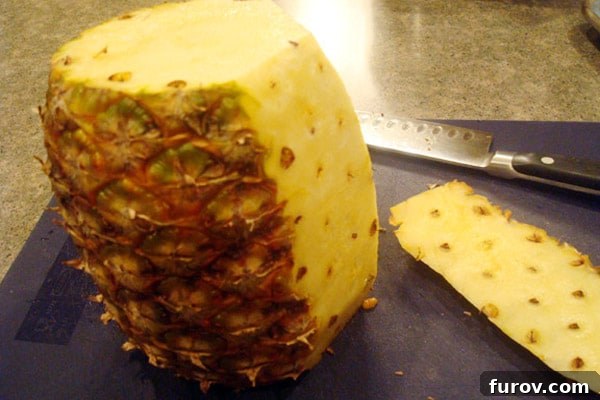
With both ends trimmed, stand the pineapple upright on your sturdy cutting board. Using your large, sharp knife, begin to carefully trim away the outer peel. Starting from the top, slice downwards, following the natural curve of the pineapple. Take off one vertical strip of peel at a time.
The key here is to make shallow cuts. Don’t worry about cutting too deeply into the delicious, juicy flesh. Your goal at this stage is simply to remove the rough, spiky outer skin. It’s perfectly fine, and even expected, to leave some of the brown “eyes” embedded in the fruit. We’ll address those pesky spots in a dedicated, more precise step.
Step 3: Revealing the ‘Naked’ Pineapple – Post-Peeling Appearance
After you’ve carefully worked your way around the entire pineapple, removing all of the rough outer peel, it should now stand “naked” on your cutting board. At this point, you’ll notice the distinct pattern of the remaining brown “eyes.” These eyes are typically arranged in diagonal rows around the fruit.
Take a moment to observe your now peeled pineapple. It should be mostly yellow, with the small, brown, circular eyes clearly visible against the backdrop of the fruit. This preparation sets the stage for the most distinctive and efficient part of this cutting method.
Step 4: Identifying the Diagonal ‘Eyes’ Pattern – The Key to Precision
This is where the magic of this method truly comes into play. Take a good, hard look at your peeled pineapple. You will clearly see that the brown spots, or “eyes,” are not randomly scattered. Instead, they line up in distinct diagonal rows, spiraling around the pineapple’s body. There are typically two intersecting sets of diagonals.
Carefully observe one set of these diagonal lines. You’ll notice how a continuous line of brown spots forms a clear path. Identifying this pattern is crucial, as it dictates the direction of your next, precise cuts, ensuring you remove the eyes with minimal fruit loss. Visualizing these lines will guide your knife work in the subsequent step.
Step 5: Mastering the ‘Eye’ Removal – Making Strategic Divots
Once you’ve clearly identified the diagonal pattern of the brown spots, it’s time to remove them. This is achieved by making shallow, V-shaped cuts, or “divots,” along these diagonal lines. Position your knife slightly to one side of a diagonal row of eyes. Make a cut that angles into the pineapple, then make another angled cut from the other side of the row, meeting the first cut at the base of the eyes. This creates a small V-shaped groove that lifts out the entire row of eyes.
Because the eyes line up so neatly in a diagonal, you can often cut one long, continuous divot for each row of spots. Work your way around the pineapple, carefully following each diagonal line of eyes until all visible brown spots have been cleanly removed. This technique is incredibly efficient and dramatically reduces the amount of edible fruit that would otherwise be lost if you were simply trying to cut out individual spots.
Step 6: Completing the Eye Removal – A Clean Pineapple
Continue making these diagonal divot cuts around the entire pineapple until every row of brown eyes has been removed. At this stage, your pineapple should look strikingly different – a smooth, golden cylinder, completely free of any brown blemishes. The surface will have a distinctive spiral pattern of V-shaped grooves where the eyes once were.
This intricate pattern is the hallmark of a perfectly prepared pineapple using this method. You’ve successfully eliminated the toughest, least palatable parts of the fruit’s outer layer while maximizing the retention of its juicy flesh. Now, your pineapple is truly ready for its next stage of transformation.
Step 7: Separating the Flesh from the Core – Accessing the Sweetness
With all the brown spots gone, it’s time to deal with the central core of the pineapple. The core is noticeably firmer and more fibrous than the surrounding fruit flesh, and most people prefer not to eat it. To remove it, stand the pineapple upright on your cutting board once more.
Using your large, sharp knife, make four long, vertical cuts down the pineapple, slicing parallel to the core. Imagine cutting the pineapple into four large, arch-shaped segments, leaving the central, cylindrical core standing intact. Carefully slice down each side, separating the juicy outer flesh from the fibrous core. The core is easily identifiable by its lighter color and harder texture in the very center of the fruit.
Step 8: Collect Your Core-Free Pineapple Segments
Once you’ve made all four cuts around the core, you will have four large, pristine, arch-shaped pieces of pineapple flesh. The central, fibrous core will be left standing alone, and can now be discarded. While some people might experiment with using the core for infused water or smoothies, for most applications, it’s best to compost or dispose of it.
At this stage, you’re just moments away from enjoying perfectly cut pineapple. These large segments are now ready for further slicing and dicing into your desired shapes and sizes.
Step 9: Prepare for Slicing – Lay Segments Flat
Take each of your four large pineapple segments and lay them flat on your cutting board. This provides a stable base for the next series of cuts, ensuring safety and uniformity as you prepare your pineapple into more manageable pieces.
Step 10: Halve the Segments – Creating Longer Pieces
With each segment lying flat, carefully cut it in half lengthwise. This will result in two longer, thinner pieces from each of your original four segments, giving you a total of eight pieces of pineapple. These pieces are still quite substantial, making them ideal for further subdivision.
Step 11: Create Strips – Further Subdivision
Now, take each of those halves and cut them in half again lengthwise. This action will transform your eight pieces into sixteen long, slender strips of pineapple. These strips are much easier to handle and are perfect for dicing into bite-sized chunks, or even for enjoying as sticks if you prefer.
Step 12: Dice into Delicious Chunks – The Final Step
Finally, take each of these pineapple strips and cut them crosswise into bite-sized chunks. The size of the chunks is entirely up to your preference – whether you like smaller pieces for fruit salads or larger, more substantial bites for snacking. Once you’ve diced all the strips, your perfectly prepared fresh pineapple is ready to be enjoyed!
Remember, pineapple contains bromelain, an enzyme that can sometimes cause a slight tingling sensation in the mouth or a mild soreness if consumed in large quantities. However, in moderation, it’s a delightful and refreshing treat.
Choosing the Perfect Pineapple: A Guide to Ripeness
The success of your pineapple cutting endeavor begins with selecting a ripe fruit. Here’s what to look for when choosing a fresh pineapple:
- Smell: A ripe pineapple should emit a sweet, tropical aroma from its base. Avoid pineapples with no smell or an overpowering, fermented scent.
- Color: While not the sole indicator, a good pineapple often has a golden-yellow color around the base and lower half. Green skin doesn’t necessarily mean unripe, but a completely green pineapple might be less sweet.
- Feel/Weight: A ripe pineapple should feel heavy for its size, indicating juiciness. It should also have a slight give when gently squeezed, but not be too soft or mushy.
- Leaves: The green leaves in the crown should be fresh and vibrant. You should be able to easily pull a single leaf from the center of the crown if the pineapple is perfectly ripe.
Storing Your Freshly Cut Pineapple
Once you’ve gone through the effort of cutting a fresh pineapple, proper storage is key to maintaining its freshness and flavor:
- Uncut Pineapple: A whole, uncut pineapple can be stored at room temperature for a day or two until ripe. Once ripe, it can be kept in the refrigerator for up to 3-5 days to extend its freshness.
- Cut Pineapple: Store cut pineapple chunks in an airtight container in the refrigerator. This will keep them fresh and delicious for 3-5 days. Avoid leaving cut pineapple out at room temperature for extended periods, as it can spoil quickly.
- Freezing: For longer storage, freeze pineapple chunks in a single layer on a baking sheet, then transfer them to a freezer-safe bag or container. Frozen pineapple is excellent for smoothies and can last for several months.
Beyond Snacking: Creative Uses for Fresh Pineapple
While fresh pineapple chunks are a delightful snack on their own, their sweet and tangy flavor makes them incredibly versatile in the kitchen. Here are just a few ideas to inspire you:
- Smoothies: A classic use! Blend fresh or frozen pineapple with other fruits, yogurt, or coconut milk for a refreshing beverage.
- Salsas: Finely diced pineapple adds a sweet and tangy kick to savory salsas, perfect for fish tacos, grilled chicken, or pork.
- Grilled Pineapple: Grilling pineapple caramelizes its natural sugars, creating a wonderfully smoky and sweet side dish or dessert. Try it with a sprinkle of chili powder for an extra zing.
- Desserts: Incorporate pineapple into upside-down cakes, tarts, fruit salads, or even a pineapple ice cream float.
- Savory Dishes: Pineapple is a fantastic addition to stir-fries, curries, and even on homemade pizza for a touch of tropical sweetness.
Nutritional Powerhouse: The Benefits of Pineapple
Beyond its incredible taste and versatility, pineapple is also packed with nutritional benefits, making it a healthy addition to any diet:
- Rich in Vitamin C: A single serving provides more than your daily recommended intake of Vitamin C, a powerful antioxidant essential for immune health.
- Manganese: This vital mineral supports bone health, metabolism, and antioxidant defenses.
- Bromelain: Pineapple is the only known source of bromelain, a group of enzymes that aid in digestion and have anti-inflammatory properties.
- Fiber: It’s a good source of dietary fiber, promoting digestive health and helping with satiety.
- Hydration: With high water content, pineapple helps keep you hydrated.
Conclusion: Enjoy Your Perfectly Prepared Pineapple!
Learning how to cut a pineapple effectively is a skill that pays dividends, transforming a potentially intimidating task into a simple, enjoyable process. By following this detailed guide, you’ve mastered a method that not only minimizes waste and maximizes yield but also leaves you with beautifully presented, delicious pineapple chunks.
Whether you’re snacking on them fresh, tossing them into a vibrant fruit salad, or incorporating them into your favorite savory recipes, you can now confidently enjoy all the tropical goodness this magnificent fruit has to offer. So grab your sharpest knife, pick a perfectly ripe pineapple, and get ready to indulge in the sweet rewards of your culinary prowess!