
No cake flour on hand for that perfect recipe? Don’t let it stop you! Discover how simple it is to whip up your own homemade cake flour quickly and effortlessly.
How to Make Homemade Cake Flour: The Secret to Perfect, Tender Bakes
Imagine this: You’ve just found the most irresistible cake recipe, promising a dessert that’s light, airy, and incredibly tender. You eagerly scan the ingredient list, ready to dive into a baking adventure, and then you see it: “cake flour.” Does your heart sink, knowing you don’t have any in the pantry? Or do you confidently smile, already aware of the simple trick to make your own?
For many home bakers, the mention of cake flour can be a deterrent. It’s not an ingredient everyone keeps on hand, and a last-minute trip to the grocery store isn’t always feasible. But what if I told you that you could easily create a fantastic homemade cake flour substitute using two common pantry staples? No more dismissing those tantalizing cake recipes! Today, we’re going to transform your baking game by showing you exactly how to make your own cake flour, ensuring perfect, tender results every single time.
Why Cake Flour Makes All the Difference in Your Baking
Before we dive into the “how-to,” let’s understand the “why.” What exactly is cake flour, and why is it so crucial for certain recipes? The magic lies in its protein content. Cake flour is a finely milled, low-protein flour, typically ranging from 6-8% protein. In contrast, standard all-purpose flour has a protein content of around 10-12%, and bread flour can be even higher.
Why does protein matter? Protein develops into gluten when mixed with liquid. More gluten means more structure, which is excellent for chewy breads, but not so much for delicate cakes. A higher gluten content can lead to a tougher, denser cake crumb. Cake flour, with its low protein, significantly reduces gluten formation, resulting in a number of desirable qualities for your baked goods:
- Incredibly Tender Crumb: The hallmark of a great cake is its melt-in-your-mouth tenderness. Low gluten ensures this.
- Finer Texture: Cakes made with cake flour often have a silkier, more uniform texture without large air pockets.
- Enhanced Moisture: The structure of cake flour helps it absorb and retain more moisture, leading to a moist, delicious cake that stays fresh longer.
- Higher Rise: Less gluten means a more delicate structure that allows the cake to rise higher and lighter during baking.
- Perfect for Delicate Bakes: Think light sponges, velvet cakes, cupcakes, and other delicate pastries where a tender, airy texture is paramount.
While some recipes might allow for all-purpose flour as a direct substitute, for truly superior results in recipes specifically calling for cake flour, there’s no real replacement for its unique properties. And that’s where our homemade solution comes in!
The Secret Ingredient: Cornstarch
So, how do we transform higher-protein all-purpose flour into a low-protein cake flour substitute? The answer is simple: cornstarch. Cornstarch is a pure starch that contains no protein. When you combine all-purpose flour with cornstarch, you effectively dilute the protein content of the flour mixture, mimicking the characteristics of commercial cake flour.
This clever addition works wonders. The cornstarch helps to weaken the gluten bonds in the all-purpose flour, creating a softer, more tender crumb. It also contributes to that desirable fine, silky texture we expect from delicate cakes. It’s an inexpensive, readily available ingredient that holds the key to unlocking your best baking yet.
Your DIY Cake Flour Workshop: Two Reliable Methods
You have two reliable methods for making homemade cake flour, both incredibly effective. Whether you prefer the convenience of measuring cups or the precision of a kitchen scale, we’ve got you covered. My personal preference leans towards the kitchen scale for its unparalleled accuracy, but either method will significantly improve your baked goods.
Let’s dive into the details. Just remember, the golden rule for both methods is sifting – and then sifting again!
Method 1: The Easy Cup and Spoon Technique
This method is perfect if you don’t own a kitchen scale or prefer volume measurements. It’s quick, straightforward, and produces excellent results as long as you pay attention to your measuring technique.
What You’ll Need:
- All-purpose flour
- Cornstarch
- Measuring cups
- Tablespoon
- Fine-mesh sifter or sieve
- Mixing bowl
Step-by-Step Instructions:
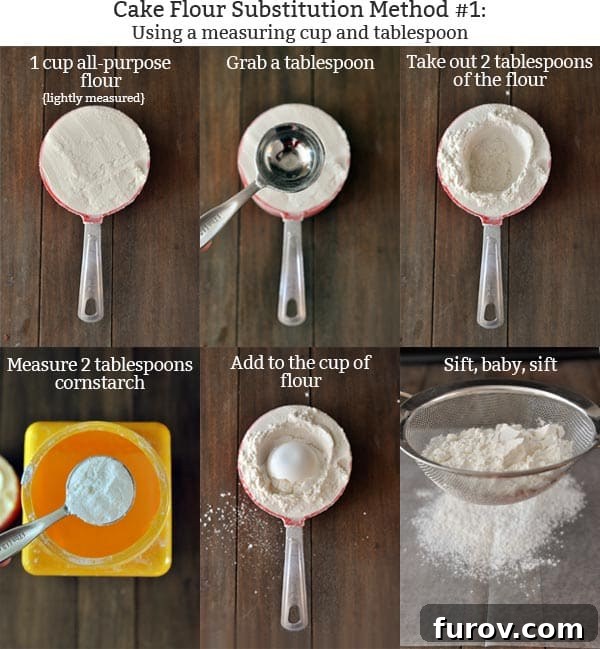
- Start with All-Purpose Flour: For every 1 cup of cake flour needed in your recipe, you will begin with 1 cup of all-purpose flour.
- Remove a Portion: Take your 1-cup measuring cup of all-purpose flour and remove 2 tablespoons of flour from it. So, you’ll be left with 1 cup minus 2 tablespoons of all-purpose flour in the cup.
- Add Cornstarch: Replace the removed 2 tablespoons of all-purpose flour with 2 tablespoons of cornstarch. Carefully level it off.
- Combine and Sift – Crucially! Transfer this mixture (1 cup all-purpose flour minus 2 tbsp, plus 2 tbsp cornstarch) into a fine-mesh sifter set over a mixing bowl. Sift the mixture together.
- Sift Again (and Again!): This step is non-negotiable. Sift the flour and cornstarch mixture at least two times, preferably three. Sifting ensures the cornstarch is perfectly distributed throughout the flour, preventing lumps and thoroughly aerating the mixture, which is vital for a light cake.
- Ready to Use: One cup of this freshly sifted homemade cake flour is now ready to be used in place of 1 cup of commercial cake flour called for in your recipe.
Important Notes for this Method:
- Do Not Pack the Flour: When measuring your all-purpose flour, resist the urge to pack it into the cup. Instead, lightly spoon the flour into your measuring cup until it overflows, then level it off with a straight edge (like the back of a knife). Packing flour can add too much flour, throwing off your ratios and making your cake dense.
- Sifting is Your Superpower: Seriously, don’t skip it. The repeated sifting not only combines the cornstarch and flour evenly but also aerates the mixture, making it lighter and contributing to a tender crumb.
Method 2: Precision with a Kitchen Scale
If you own a kitchen scale, this is hands down the most accurate and consistent way to make your homemade cake flour. Baking is a science, and scales remove the variability of volume measurements, ensuring consistent results every time.
What You’ll Need:
- All-purpose flour
- Cornstarch
- Digital kitchen scale
- Fine-mesh sifter or sieve
- Mixing bowl
Step-by-Step Instructions:
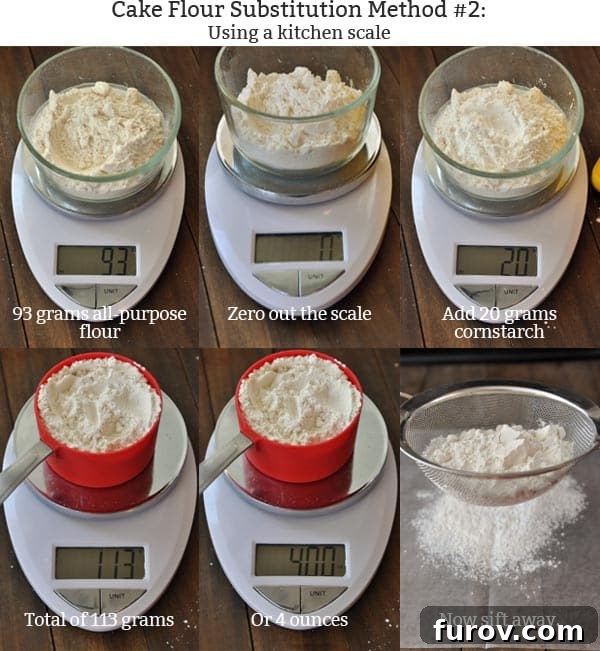
- Understand the Weight: A standard cup of cake flour weighs approximately 4 ounces (or 113 grams). Our goal is to create a mixture that mimics this weight and protein ratio.
- Measure the Cornstarch: For every 1 cup of cake flour you need, measure out 0.7 ounces (approximately 20 grams) of cornstarch. Place this in your mixing bowl.
- Measure the All-Purpose Flour: Add all-purpose flour to the cornstarch until the total weight reaches 4 ounces (113 grams). This means you’ll be adding approximately 3.3 ounces (93 grams) of all-purpose flour.
- Combine and Sift with Vigor: Just like with the cup method, you must sift! Combine the weighed flour and cornstarch in a fine-mesh sifter over a clean bowl. Sift the mixture at least two or three times. This ensures the cornstarch is perfectly integrated and the flour is beautifully aerated.
- Ready to Bake: You now have 1 cup (by weight, 4 ounces/113 grams) of homemade cake flour, ready to be used in your recipe.
Why a Scale is Superior:
- Unmatched Accuracy: While volume measurements (cups) can vary wildly based on how you scoop or pack, a scale provides an exact weight every time, leading to more consistent baking results.
- Reproducibility: Once you’ve perfected a recipe, using a scale ensures you can reproduce those exact results time and again.
- Inexpensive Investment: Good digital kitchen scales are quite affordable. I highly recommend investing in one if you’re serious about baking. This kitchen scale is a great example of an affordable and reliable option.
Important Notes & Pro Tips for Perfect Homemade Cake Flour
To ensure your homemade cake flour delivers the best possible results, keep these essential tips in mind:
- Always Use All-Purpose Flour: This method is specifically designed for all-purpose flour. Do not substitute with self-rising flour (which contains leavening agents and salt) or bread flour (which has an even higher protein content).
- Sifting, Sifting, Sifting: I cannot stress this enough. Sifting isn’t just about mixing; it’s about aerating the flour and cornstarch. This step breaks up any clumps, evenly distributes the cornstarch, and incorporates air, all of which contribute to a lighter, more tender cake. Two or three times is ideal. Think of it as a little arm workout for a delicious reward!
- Yield and Adjustments: Both methods described above will yield approximately 1 cup of homemade cake flour. If your recipe calls for more, simply multiply the ingredients accordingly. For example, for 2 cups of cake flour using the cup method, you would start with 2 cups of AP flour, remove 4 tablespoons, and add 4 tablespoons of cornstarch, then sift vigorously.
- Storage: If you make more homemade cake flour than you need, store it in an airtight container in a cool, dry place, just as you would with commercial flour. It will keep for as long as your all-purpose flour would.
- Common Mistakes to Avoid:
- Over-packing flour: Leads to too much flour by weight.
- Skipping the sifting: Results in uneven distribution and a less airy texture.
- Using the wrong type of flour: Will drastically alter the outcome.
When to Use Your Homemade Cake Flour
Now that you’re a homemade cake flour expert, you might be wondering which recipes truly benefit from this specialty flour. The answer is any recipe where a delicate, tender, and moist crumb is desired! Here are some classic examples:
- Layer Cakes: Especially white, yellow, or chocolate layer cakes that demand a fine, velvety texture.
- Cupcakes: For light, fluffy, and consistently moist results.
- Pound Cakes: While traditionally dense, cake flour can give pound cakes a slightly lighter, more refined crumb.
- Sponge Cakes and Chiffon Cakes: Where airiness and tenderness are paramount.
- Muffins and Quick Breads: For a softer, less chewy texture than using all-purpose flour alone.
While homemade cake flour is incredibly versatile, it’s generally not ideal for recipes where chewiness or strong gluten development is desired, such as rustic breads, chewy cookies, or some pizza doughs. For those, stick to your higher-protein flours!
Frequently Asked Questions About Homemade Cake Flour
- Q: Is homemade cake flour exactly like store-bought cake flour?
- A: While not exactly identical (commercial cake flour is often bleached, which further weakens gluten bonds), this homemade substitute is incredibly close and performs beautifully in almost all recipes calling for cake flour. It’s an excellent, reliable alternative.
- Q: Can I use self-rising flour instead of all-purpose flour?
- A: No. Self-rising flour already contains baking powder and salt. Adding cornstarch to it would mess with the leavening balance and potentially ruin your recipe.
- Q: What if I don’t have cornstarch? Are there any alternatives?
- A: Cornstarch is the best and most reliable option. In a pinch, you *could* try arrowroot powder or potato starch, but cornstarch is generally preferred for its neutral flavor and consistent results in baking.
- Q: How long can I store homemade cake flour?
- A: Store it in an airtight container in a cool, dry pantry, just as you would with regular flour. It should remain good for as long as your all-purpose flour would have been.
- Q: Can I make a large batch to keep on hand?
- A: Absolutely! Simply scale up the amounts proportionally for either method. Just remember to store it properly.
Master Your Baking Destiny
There you have it! The simple, foolproof guide to making your own cake flour at home. No more last-minute ingredient scrambles or passed-over recipes. By understanding the role of low-protein flour and utilizing the magic of cornstarch, you’ve equipped yourself with a powerful baking hack that will elevate your cakes from good to truly extraordinary.
Embrace the science, enjoy the process, and revel in the incredibly tender, fine-crumbed cakes you’re about to create. So go ahead, dust off that recipe that calls for cake flour – you’re totally prepared. Happy baking!