
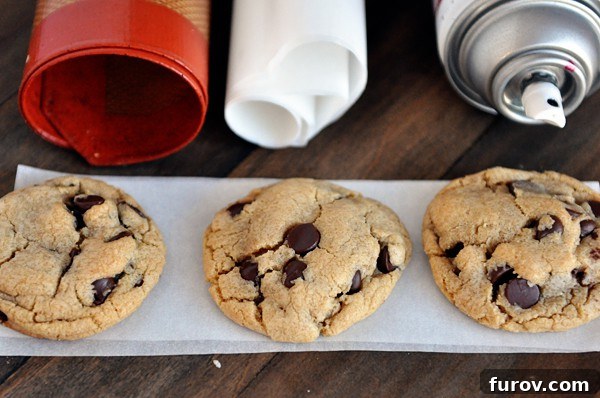
Welcome back to The Great Cookie Experiment! Our ongoing quest to uncover the secrets behind baking consistently perfect cookies continues. In previous installments, we delved into the critical role of butter temperature and the surprising impact of chilling your cookie dough. Today, we’re tackling another fundamental question that often perplexes home bakers, yet plays a pivotal role in the final texture and appearance of your sweet creations.
Mastering Your Baking Surface: What Should You Line Your Cookie Sheets With?
The choice of what to line your baking sheets with might seem minor, but as our experiment will reveal, it significantly influences the bottom browning, crispiness, and overall appeal of your cookies. Achieving that perfect balance – a tender center with just the right amount of chew or crisp at the edges – often comes down to this often-overlooked detail. This comprehensive guide will help you understand the pros and cons of the most popular baking sheet liners, ensuring your next batch of cookies is nothing short of perfection.
Setting the Stage: Our Cookie Experiment Methodology
Before diving into the delectable results, let’s establish the parameters for this particular baking endeavor. It’s crucial for any scientific experiment, even a delicious one like this, to maintain consistency across variables to ensure accurate conclusions.
Focus on the Liner, Not the Pan
For this experiment, our sole focus was on the material placed *on* the baking pan, not the pan type itself. Factors such as pan material (aluminum, steel), color, and thickness can all influence heat transfer, making it a complex variable for a separate study. To keep our findings clear and directly attributable to the liners, we exclusively used standard, rimmed 12×18-inch aluminum baking sheets. These commercial-grade sheets, commonly found in bulk at stores like Sam’s Club, are known for their even heat distribution and durability, making them an excellent neutral canvas for our test.
The Perfect Test Subject: Classic Chocolate Chip Cookies
To ensure our observations were widely applicable, we opted for a beloved classic: our Perfect Chocolate Chip Cookie recipe. This recipe consistently yields a drop-type cookie with a balance of chewiness and a slight crisp that makes it an ideal candidate for assessing subtle textural differences. While our experiment used this specific recipe, the insights gained regarding heat transfer and surface interaction can be broadly applied to almost any other drop-style cookie, from oatmeal raisin to peanut butter blossoms. All cookies were baked in a preheated 350-degree Fahrenheit oven for a consistent 11.5 minutes, ensuring that any variation in results stemmed directly from the lining material.
The Contenders: Silpat, Parchment Paper, and Cooking Spray
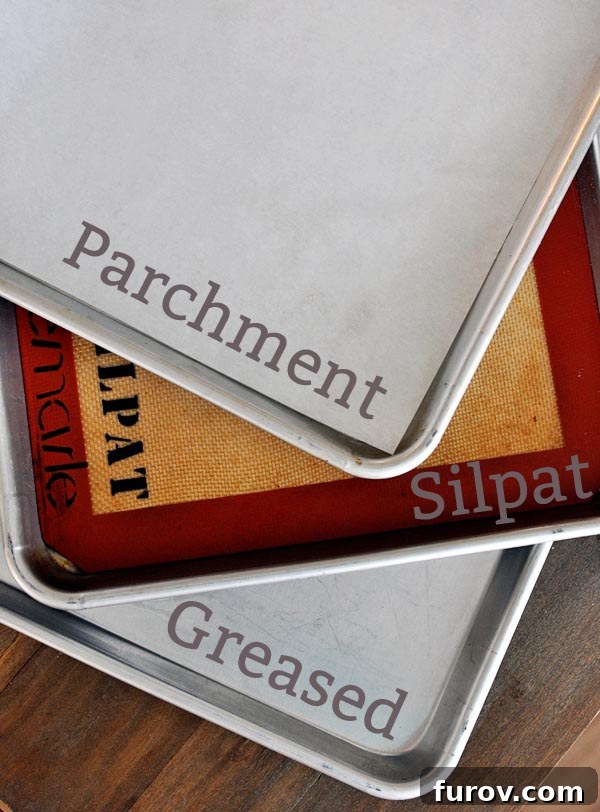
We pitted three popular baking sheet lining options against each other: the reusable silicone baking mat (Silpat), disposable parchment paper, and a simple coating of cooking spray directly on the metal baking sheet. Each promises a non-stick surface, but their performance and impact on the final cookie differ significantly.
Initial Observations: A Glimpse from Above
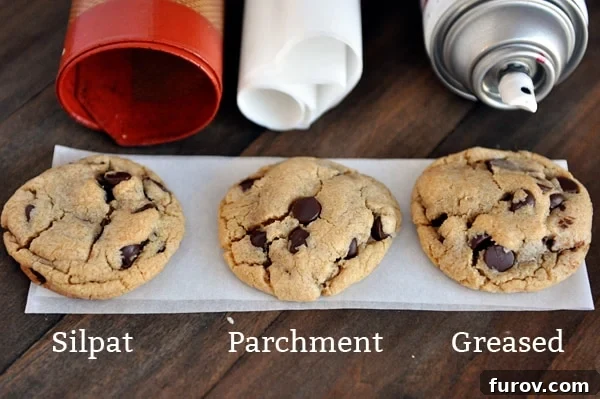
Upon initial inspection, fresh out of the oven, the cookies baked on each of the three surfaces looked remarkably similar from the top. The overall shape, golden-brown edges, and general appearance of the upper surface showed very little variation. Even under close scrutiny – the kind that involves a ruler and millimeter measurements, a confession I might or might not make about my own “neurotic dork” moment – the differences in how much they flattened were minimal. Most home bakers would likely not notice a significant distinction in the top appearance unless they were specifically looking for minute variations.
This tells us that for the most part, the liner choice primarily affects the interaction between the cookie dough and the hot baking surface, rather than the overall rise or spread. The internal texture of the cookies, regardless of the liner, also remained quite consistent across all batches – all boasting that delightful chewy center that makes a chocolate chip cookie so irresistible.
The Unsung Hero: The Bottom of the Cookie
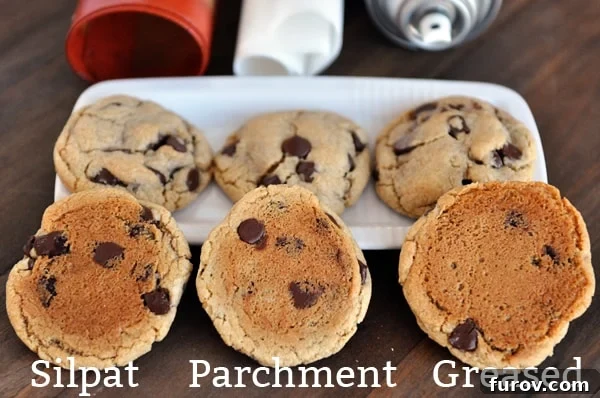
While the tops told a story of uniformity, flipping the cookies over revealed the true impact of our lining choices. The bottoms of the cookies presented a far more diverse landscape of browning and crispiness. This is where the physics of heat transfer between the hot metal baking sheet and the cookie dough truly comes into play.
Parchment Paper: The Soft Touch
The cookies baked on parchment paper exhibited noticeably less browning on their bottoms. This is due to parchment acting as a thin, insulating barrier between the raw dough and the intensely hot metal of the baking sheet. It moderates the direct heat, preventing the rapid caramelization and browning that occurs with direct contact. The result? These cookies emerged from the oven with a lighter, more evenly golden bottom. Crucially, after cooling, the parchment-baked cookies remained remarkably softer and less crispy on the bottom. If your ideal cookie boasts a tender, melt-in-your-mouth bottom with minimal crunch, parchment paper is undeniably your best friend.
Greased Baking Sheet: The Crisp Enthusiast
In stark contrast, cookies baked directly on a greased baking sheet (using cooking spray in our experiment) showed significantly more browning and crispiness, particularly around the edges. The direct contact with the hot, greased metal facilitates more intense heat transfer. The fat from the cooking spray also aids in browning and can create a fried-like effect on the cookie’s underside. While still warm, the difference was present, but after cooling, these cookies became almost crumbly and quite crispy around their periphery. For those who crave a cookie with a pronounced crunchy edge and a well-browned bottom, a greased sheet might appeal, but vigilance with baking time is essential to avoid over-browning or burning.
Silpat Liner: The Balanced Performer
Silicone baking mats, like Silpat, offered a middle ground between parchment and the greased sheet. These reusable mats also provide an insulating layer, similar to parchment, but with a slightly different heat conduction profile. The cookies baked on Silpat liners had firm bottoms that were still somewhat soft in the center, striking a balance. They didn’t achieve the extreme crispiness of the greased sheet, nor the delicate softness of the parchment-lined cookies. The silicone surface promotes even baking and prevents sticking without excessive browning, making it a reliable choice for consistent results.
The Verdict: Choosing Your Perfect Baking Partner
After a thorough analysis, including taste tests of warm and cooled cookies (purely for scientific rigor, of course!), our preference leaned towards the cookies baked on parchment-lined baking sheets for their consistently softer, less crispy bottoms once cooled. However, it’s important to stress that none of the methods were inherently “bad.” The ideal liner truly depends on your desired cookie outcome.
If you prefer a softer, chewier cookie with a less pronounced browned bottom, parchment paper is your champion. Its ability to shield the dough from direct, intense heat ensures a more tender underside. If you find your cookies consistently over-browning on the bottom, switching to parchment is an easy fix.
For those who enjoy a firmer base and don’t mind a slight crisp, Silpat liners are an excellent, reusable option. The key, however, lies in adjusting your baking time. For both Silpat and greased sheets, reducing the baking time by a minute or two compared to parchment might be necessary to achieve a similar level of bottom doneness and prevent excessive browning. The most direct heat transfer from the greased sheet creates the crispiest, most browned edges, which can be desirable for some, but also the most prone to over-baking if not carefully monitored.
Ultimately, while all three options effectively prevent sticking, their impact on texture is undeniable. If you wish to minimize crunch and achieve a softer cookie bottom, we would generally advise against the greased baking sheets unless you are meticulously watching your oven.
My Go-To Choices: Convenience Meets Performance
In the world of home baking, convenience often plays a significant role. Despite the subtle advantages parchment paper showed for bottom texture, I haven’t abandoned my Silpat liners. In fact, they are my everyday workhorse, used for approximately 99% of my cookie baking. I love the ease of reusing them over and over. While they require washing and drying, their longevity makes them an environmentally friendly and cost-effective choice in the long run. I’ve had my two Silpat mats for over five years, and they still perform beautifully – a testament to their durability. From now on, though, I’ll be mindful to slightly decrease the baking time when using them, aiming for that perfect balance of firm and soft.
As for parchment paper, it’s an indispensable staple in my kitchen that I simply couldn’t live without. It comes into play when all four of my baking sheets are in use, and I don’t have enough Silpat liners to go around for a large batch. The cleanup is, of course, a dream – simply toss it away! While not as “green” as reusable silicone mats, its convenience is unparalleled. Beyond cookies, parchment paper is incredibly versatile; I use it to line cake pans (cut to size), wrap quick breads tied with twine for gifting, and even as a non-stick surface for baking pizzas directly on a pizza stone. I almost exclusively purchase my parchment paper from King Arthur Flour, not because I’m affiliated, but because their quality is consistently excellent. I also practice a bit of eco-consciousness by reusing sheets several times before discarding them, provided they aren’t excessively greasy or soiled.
This experiment, while seemingly simple, highlights the nuanced world of baking science. Every element, from butter temperature to the chosen baking surface, contributes to the final masterpiece. Understanding these subtle interactions empowers us to bake with greater precision and achieve the results we truly desire.