
Welcome to the second compelling chapter of The Great Cookie Experiment, where we meticulously dissect common baking wisdom to uncover the secrets behind truly exceptional cookies.
If you missed our inaugural round, which explored the crucial impact of butter temperature on cookie texture and spread, we highly recommend reading it here. The insights shared there could very well be life-changing for your baking endeavors, providing foundational knowledge for achieving perfect results every time.
The Ultimate Chocolate Chip Cookie Experiment: Does Chilling Dough Really Make a Difference?
Today, our focus shifts to a topic that has sparked fervent debate within the chocolate chip cookie community: the practice of chilling cookie dough prior to baking. Many prominent and immensely popular recipes, including the famed New York Times version, advocate for refrigerating dough for an extended period—often 24 to 36 hours—claiming it significantly develops flavor and enhances texture. This theory has taken the baking world by storm, promising superior results for those willing to wait.
The question of dough chilling consistently surfaced in the comments section of our first experiment, highlighting its widespread curiosity among home bakers. You asked, and we listened! This pressing issue was swiftly added to our short list of upcoming cookie investigations, leading us to today’s crucial experiment.
Understanding the Science: Why the Chilling Debate Exists
Before diving into our practical experiment, let’s briefly explore the theoretical benefits attributed to chilling cookie dough. Proponents suggest several key advantages, each rooted in the chemistry and physics of baking:
- Flavor Development: Over time, as the dough rests in the refrigerator, the moisture from the flour has more opportunity to fully hydrate. Simultaneously, complex sugars can break down into simpler compounds through enzymatic reactions. This process, often likened to aging fine wine or cheese, is believed to concentrate and deepen the flavors, resulting in a more complex, nuanced, and richer-tasting cookie.
- Texture Enhancement: Chilling solidifies the butter and other fats within the dough. When this cold, firm dough is placed into a hot oven, the butter takes longer to melt and spread. This extended melting time allows the cookie’s structure to set more firmly before spreading, typically leading to a thicker, chewier cookie with desirable crispy edges and a soft, yielding center. In contrast, warm dough with soft butter tends to spread rapidly, often resulting in flatter, thinner, and sometimes greasier cookies.
- Reduced Spread: As a direct consequence of solidified fat, chilled dough is less prone to excessive spreading during baking. This is particularly beneficial for recipes that might otherwise yield cookies that are too thin or lose their shape.
- Moisture Redistribution: The resting period in the cold also allows for a more even distribution of moisture throughout the flour and other dry ingredients. This uniform hydration contributes to a more consistent dough texture and a more predictable bake, preventing dry spots or overly moist areas within the cookie.
So, with these compelling claims in mind, what’s a dedicated experimenter to do? The answer was clear: it was time to chill some dough already! We were ready to put these popular theories to the ultimate test in a real-world baking scenario, meticulously documenting every step and outcome.
Our Scientific Approach: The Great Cookie Experiment Continues
For this experiment, maintaining rigorous consistency was paramount to ensure reliable results. We started with the same basic chocolate chip cookie dough recipe that served as our trusted control in the first round of tests focusing on butter temperature. This classic, straightforward recipe specifically calls for room temperature butter. For the purposes of this specific chilling investigation, I ensured the butter used was at a perfectly cool room temperature, meticulously avoiding any variables that could arise from overly soft or excessively hard butter, thus isolating the chilling variable.
Dough Preparation and Meticulous Division
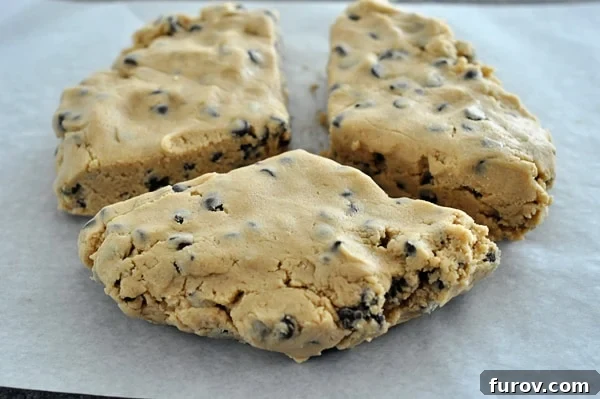
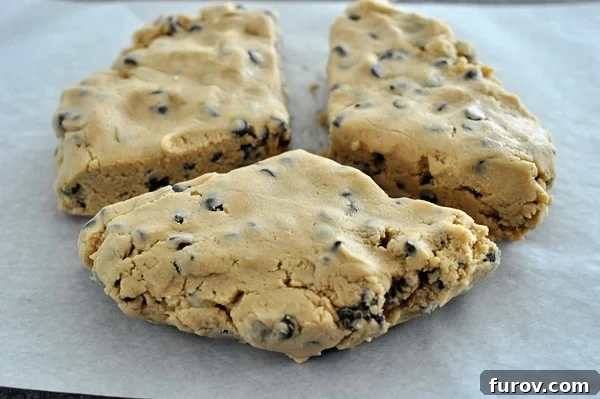
To accurately compare the effects of varying chilling durations, I meticulously divided the freshly prepared dough into three distinct sections. Each section was carefully portioned to ensure an equitable comparison and eliminate any size-related biases:
- One generous portion of cookie dough was designated to be baked right away. This batch served as our crucial immediate-bake control, providing a baseline for comparison.
- The second portion was securely wrapped in plastic film to prevent drying and then placed in the refrigerator for a precise duration of 24 hours before baking.
- The third, equally proportioned section, was prepared and wrapped identically, then set aside for an extended chill of 48 hours. (While some recipes suggest 36 hours, practical considerations related to my baking schedule necessitated choosing between 24 and 48 hours for the next logical experimental step.)
Each dough chunk was handled and prepared identically before its designated chilling or immediate baking. This careful preparation ensured that the only significant variable across the batches was the duration of refrigeration, allowing us to attribute observed differences directly to the chilling process.
Standardized Baking Process and Conditions
Once the respective chilling periods were complete (or for the immediate batch, directly after mixing), each cookie, regardless of its chilling time, was precisely measured at approximately 1.5 tablespoons of dough. They were all uniformly baked for the same exact amount of time—11 minutes in my oven, a duration consistently yielding optimal results for this particular recipe. This strict standardization ensured that any differences observed in the final cookies could be attributed solely to the chilling process, rather than variations in baking time, dough portioning, or oven conditions.
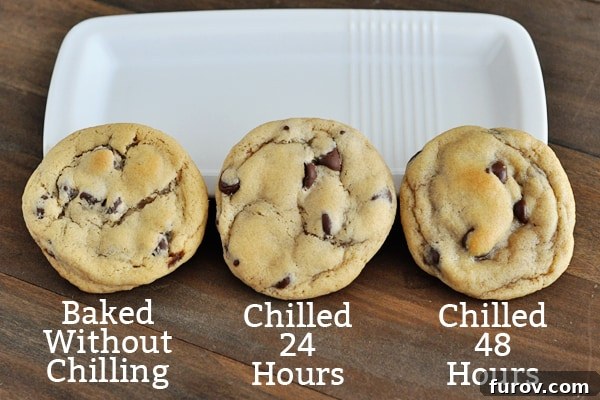
Here’s a visual lineup of the beautifully baked cookies, all presenting an inviting appearance. Now, let’s delve deeper into the specific results and characteristics of each batch, meticulously examining their unique attributes.
The Results Unveiled: A Detailed Look at Each Cookie Batch
Batch 1: The Instant Gratification Cookie (Baked Immediately)
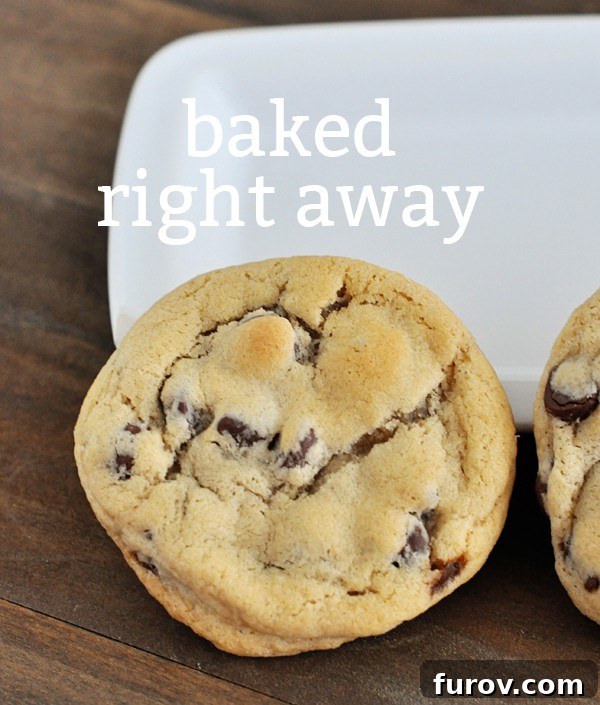
This beloved cookie was baked directly after the dough was mixed, without any refrigeration. As anticipated, it delivered all the delightful qualities I’ve come to expect and cherish from a classic chocolate chip cookie. It was perfectly soft and chewy, possessing a delightful tenderness that defines a truly satisfying homemade treat. It held its shape beautifully, with a slightly puffy, golden-brown center and edges that were just beginning to crisp, creating a pleasant contrast in textures. This is the quintessential cookie I’ve enjoyed countless times over the years, a testament to its consistent deliciousness even without the planning required for chilling. For those moments when a sudden cookie craving strikes, and I want cookies right now, this immediate-bake method rarely disappoints, delivering pure, unadulterated pleasure.
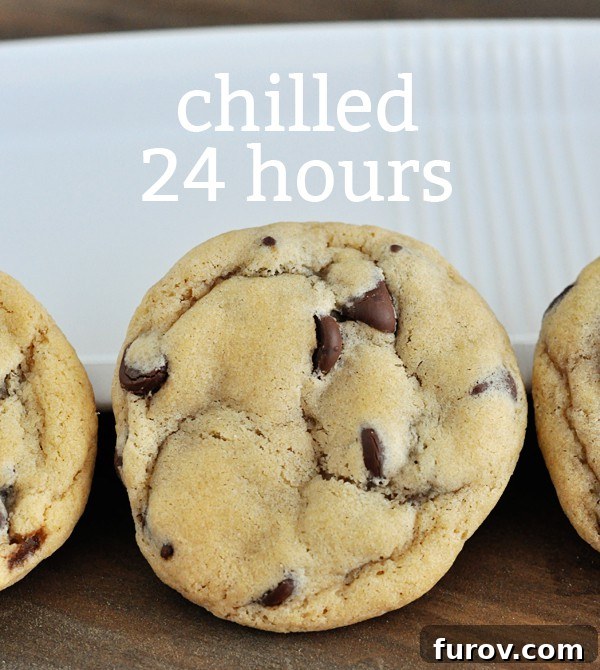
Batch 2: The 24-Hour Transformation Cookie
Next, we meticulously sampled the cookie that had been chilled for 24 hours prior to baking. Visually, this cookie presented a slightly lighter brown hue compared to its immediate-bake counterpart, a subtle difference observed despite being baked for the identical duration. However, its texture was remarkably soft and noticeably less cakey than the first batch. This 24-hour chilled cookie offered a distinctly more buttery taste. The flavors felt slightly more integrated, deeper, and richer, contributing to a truly satisfying and gourmet-like experience.
Handling the dough, however, presented a minor but noteworthy challenge. Due to the extended chilling, the dough became quite firm and dense, making it impossible to scoop cleanly with a standard cookie scoop. This was a definite point against chilling in my personal assessment, as I treasure my cookie scoop for its efficiency and precision, considering it almost like a sixth child! Instead, I had to manually dig out portions of the stiff dough from the bowl, approximate the size by eye, and then diligently roll each piece between my palms to form individual balls.
Achieving a perfectly round shape before baking was therefore a bit harder because of the dough’s increased stiffness and reduced pliability. Despite this minor inconvenience in dough handling, there was an undeniable upside: the sheer convenience of waking up in the morning to perfectly ready-to-bake cookie dough patiently waiting in the refrigerator. The thought of warm, freshly baked cookies before 9 a.m. (which we may or may not have enjoyed for breakfast—purely for scientific purposes, of course!) was incredibly appealing and truly elevated the morning routine.
Batch 3: The 48-Hour Enigma Cookie
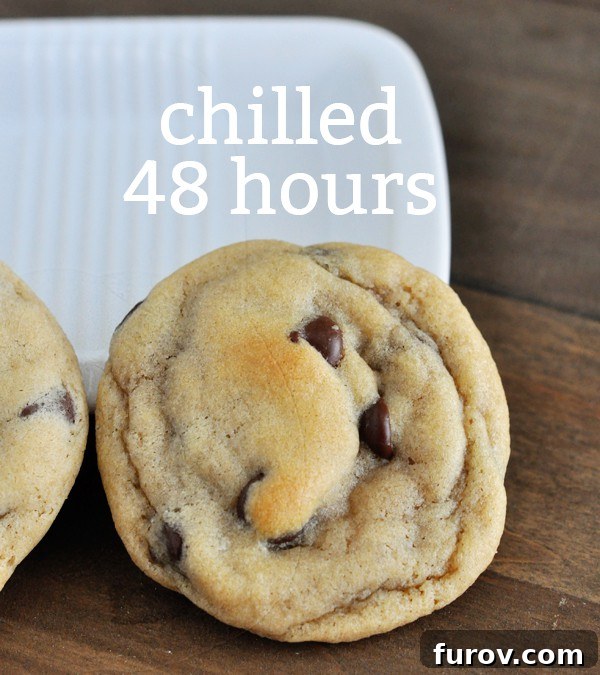
Finally, we approached the 48-hour chilled cookie, the longest chilling period in our experiment. The challenges encountered with the 24-hour dough—its firmness, difficulty in scooping, and the persistent need for manual shaping—were even more pronounced here. The dough was exceptionally stiff, requiring considerable effort to portion and shape. Yet, the conceptual convenience of having pre-made dough patiently waiting in the fridge remained a notable theoretical advantage.
This particular cookie, however, proved to be the most perplexing and truly confused and befuddled me. Despite being baked for the identical 11 minutes as the other batches, and even exhibiting lovely golden notes on its exterior, the interior of the cookie remained strikingly doughy. What was even more perplexing was an almost unpleasantly greasy texture that permeated the entire cookie. To thoroughly rule out any possibility of underbaking, I even extended the baking time for a few cookies in this batch by an additional minute, carefully monitoring them. Yet, the result remained stubbornly consistent: still overly doughy and distinctly greasy, suggesting an issue beyond simple baking time.
In-Depth Analysis: A Sensory Comparison of Flavor and Texture
Let’s talk about the two most critical aspects of any cookie that truly define its success: texture and flavor. I must be transparent here, as I’ve never claimed to possess a highly refined palate capable of detecting the most minute nuances, but rather a practical one focused on genuine deliciousness and satisfying results. From my assessment, I honestly didn’t discern a huge difference in overall flavor across the batches, with one notable and very welcome exception.
The 24-hour chilled cookie undeniably boasted a more pronounced, delightful buttery flavor. This enhancement contributed to its richness without making it feel overly heavy or greasy, which was a clear positive and arguably the most significant flavor improvement. Beyond this specific enhancement, a groundbreaking flavor revelation, as often touted by chilling advocates, didn’t materialize as dramatically as one might expect for this particular, simple chocolate chip cookie recipe.
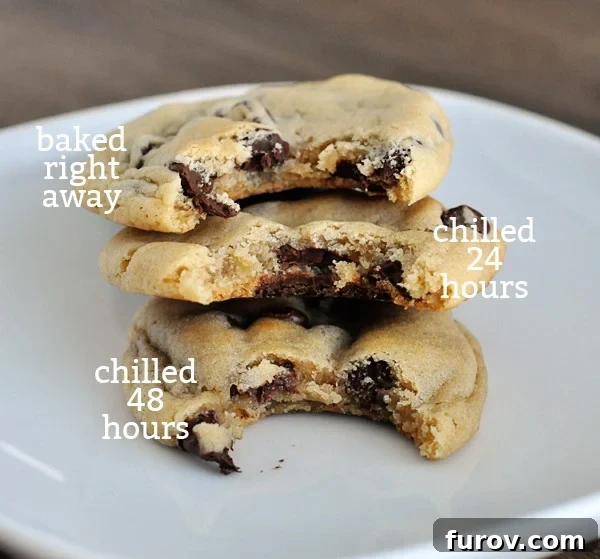
Regarding texture, the visual evidence in the picture below might suggest a superficial similarity among them. However, a closer examination and, more importantly, a rigorous side-by-side taste test revealed subtle but significant distinctions that truly set them apart. As I noted earlier, the cookie baked immediately after mixing possessed a slightly cakier texture. This subtle difference might not have been apparent had I not tasted it alongside the other cookies – yes, this arduous but necessary sensory evaluation was a real sacrifice for science! This immediate-bake cookie felt marginally less buttery and slightly drier compared to its 24-hour chilled counterpart, which felt more supple.
The 48-hour cookie, unfortunately, was a significant departure from ideal cookie texture. Its unpleasantly greasy and overtly doughy interior made it the least appealing of the three. While the exterior hinted at proper baking with its golden hue, the interior suggested a breakdown in structure or perhaps an over-saturation and separation of fat and moisture, leading to an undesirable and heavy mouthfeel. Naturally, being a very thorough scientist committed to empirical data, I still conducted multiple taste tests from each cookie in the batch, just to be absolutely certain of my findings and leave no room for doubt.
The Verdict: To Chill or Not to Chill Your Chocolate Chip Cookie Dough?
After this extensive and highly enjoyable (mostly!) investigation, here’s what I’ve learned and how I genuinely feel about chilling chocolate chip cookie dough. This is crucial, so pay close attention: Chilling the dough did not entirely convince me that it’s a mandatory, everyday step for every single batch of cookies I make. For years, I’ve successfully produced thousands of delicious cookies without ever refrigerating the dough, and in this experiment, I honestly didn’t observe a truly remarkable, universally superior change in taste and texture solely due to the chilling process for my go-to recipe.
For me, the practicality often trumps minor perceived enhancements. I rarely plan ahead 24 or 48 hours for cookies. Chocolate chip cookies in my home are synonymous with spontaneous joy, immediate comfort, and instant gratification. The idea of waiting an entire day or two for a warm, freshly baked cookie simply doesn’t align with a sudden craving or the desire for a quick, comforting treat. My household simply isn’t set up for that kind of delayed gratification when a cookie emergency arises!
However, the undeniable convenience of chilled cookie dough cannot be understated. Having pre-made dough patiently waiting, ready to bake at a moment’s notice—perhaps for unexpected guests, a last-minute school treat, or simply to streamline a busy morning—is an undeniable benefit. In this specific scenario, the “make-ahead” aspect of chilling presents a compelling argument for its utility, offering flexibility to busy bakers.
Based on our findings, particularly the somewhat disappointing outcome of the 48-hour cookie (which proved too doughy and unpleasantly greasy), my recommendation is clear: if you choose to chill your dough, I would advise chilling for no more than 24 hours. This duration offered the most pleasant balance of subtle texture improvement and that desirable buttery flavor enhancement without introducing the negative effects observed with extended refrigeration.
If you’re baking chocolate chip cookies for a truly special event, to impress discerning guests, or for someone who possesses the most refined palate in the universe, then by all means, consider chilling your dough for a day. This might provide that extra nuance and slight edge you’re aiming for. Otherwise, for everyday deliciousness and spontaneous baking, skipping the chill and baking immediately is perfectly acceptable and still yields fantastic results. Alternatively, for future convenience without the extended wait, you can always roll the dough into individual balls and freeze them, a method similar to this clever gift idea, allowing you to bake fresh cookies from frozen whenever the mood strikes.
Important Disclaimers and My Personal Baking Philosophy
It’s crucial to reiterate that this chilling experiment’s results only apply directly to the specific basic cookie dough recipe I used. Baking is a precise science, but also a creative art, and every recipe is formulated differently, with unique ratios of fat, sugar, and flour. For other recipes that explicitly require or strongly recommend chilling the dough—especially those known to spread excessively or fall flat without it, or those with very high fat content—you should absolutely heed those instructions. There’s often a well-founded scientific or practical reason behind a recipe developer’s specific guidance, and ignoring it could lead to suboptimal results.
However, I must confess: I am a bit of a rebellious baker at heart. I have been known, on occasion, to bake cookies right away even when a recipe implicitly or explicitly suggests chilling. And often, to my delight, they turn out perfectly fine! So, no judging here, please—we all have our baking quirks. Conversely, I have also diligently chilled dough when a recipe specifically called for it, such as for a recent batch of Salted Peanut Butter Cup Dark Chocolate Cookies, and the results were phenomenal. The lingering question remains: would they have been equally great without the chilling? I didn’t have the time to conduct that comparative test. My ultimate encouragement to you, the home baker, is to use your best judgment, get to know your specific recipes intimately, and don’t be afraid to experiment within reasonable limits to discover what works best for you and your palate.
One final, interesting note not included as a separate experimental batch because it yielded no discernible difference: I briefly chilled a portion of the dough for just one or two hours. Those cookies were identical in every measurable way to the “baked immediately” cookies in terms of texture, spread, and flavor. This suggests that very short chilling periods (under a few hours) might not offer the significant benefits often associated with longer refrigeration, at least for this particular recipe. Just an FYI for those considering a quick chill as a shortcut.
Wrapping Up: Onward to More Cookie Discoveries!
And with that, our deep dive into the fascinating world of chocolate chip cookie dough chilling concludes! I hope this detailed experiment provides valuable insights and empowers you in your own cookie adventures, whether you choose to chill or embrace the spontaneity of immediate baking. Stay tuned for the next exciting installment of The Great Cookie Experiment, where we’ll likely explore the fascinating world of baking pans—specifically, what materials or linings make for the best cookie bottom and contribute to that perfect chew and crispness. It promises to be equally insightful and delicious!